
Building a 5-level competency framework, from template to 360
A competency framework only works when every level has observable behavioural indicators. How to group competencies, write a 5-level ladder, attach it to positions and use it for 360s and IDPs.
Many companies have had a "competency framework" at some point: a spreadsheet listing a few dozen competencies such as "communication", "teamwork" and "strategic thinking", each scored from 1 to 5. After the first review cycle, the file sits untouched in a shared folder. The reason is usually the same: reviewers cannot tell how "communication level 3" differs from "level 4", so everyone scores 3 or 4, and the results are useless for training or promotion. This article walks through building a competency framework that actually works: competency groups, a five-level ladder with behavioural indicators, mapping to positions, and connecting it to 360 reviews and individual development plans.
What a competency framework is and why it often fails
A competency framework is the set of competencies an organisation expects from its people, with a description of proficiency levels for each. It answers three questions: which competencies does this position need, at what level, and where is the current incumbent.
Competency frameworks fail for three common reasons:
- Levels described with adjectives. "Good communicator" and "very good communicator" cannot be observed. Two managers will score the same employee differently.
- Too many competencies. If one position carries 20 competencies, none of them is assessed properly.
- No link to what happens next. If results do not lead to training, rotation or succession, employees see competency assessment as paperwork.
Four competency groups
A common, practical split is four groups:
| Group | Applies to | Examples |
|---|---|---|
| Core | Everyone in the organisation | Communication, problem solving, customer orientation |
| Functional | By function or department | Negotiation, project management, complaint handling |
| Leadership | Managers at every level | People management, strategic thinking |
| Technical | Specific professional skills | Data analysis, programming, tax accounting |
Core competencies reflect shared culture and values, so keep them few and stable (3–6). Functional and technical competencies vary by position. Leadership competencies are attached only to roles with management responsibility.
A five-level ladder with behavioural indicators
The most important part of a competency framework is the behavioural indicator: a description of what someone at that level can do, observable at work. A common five-level ladder runs Basic, Developing, Proficient, Advanced, Expert.
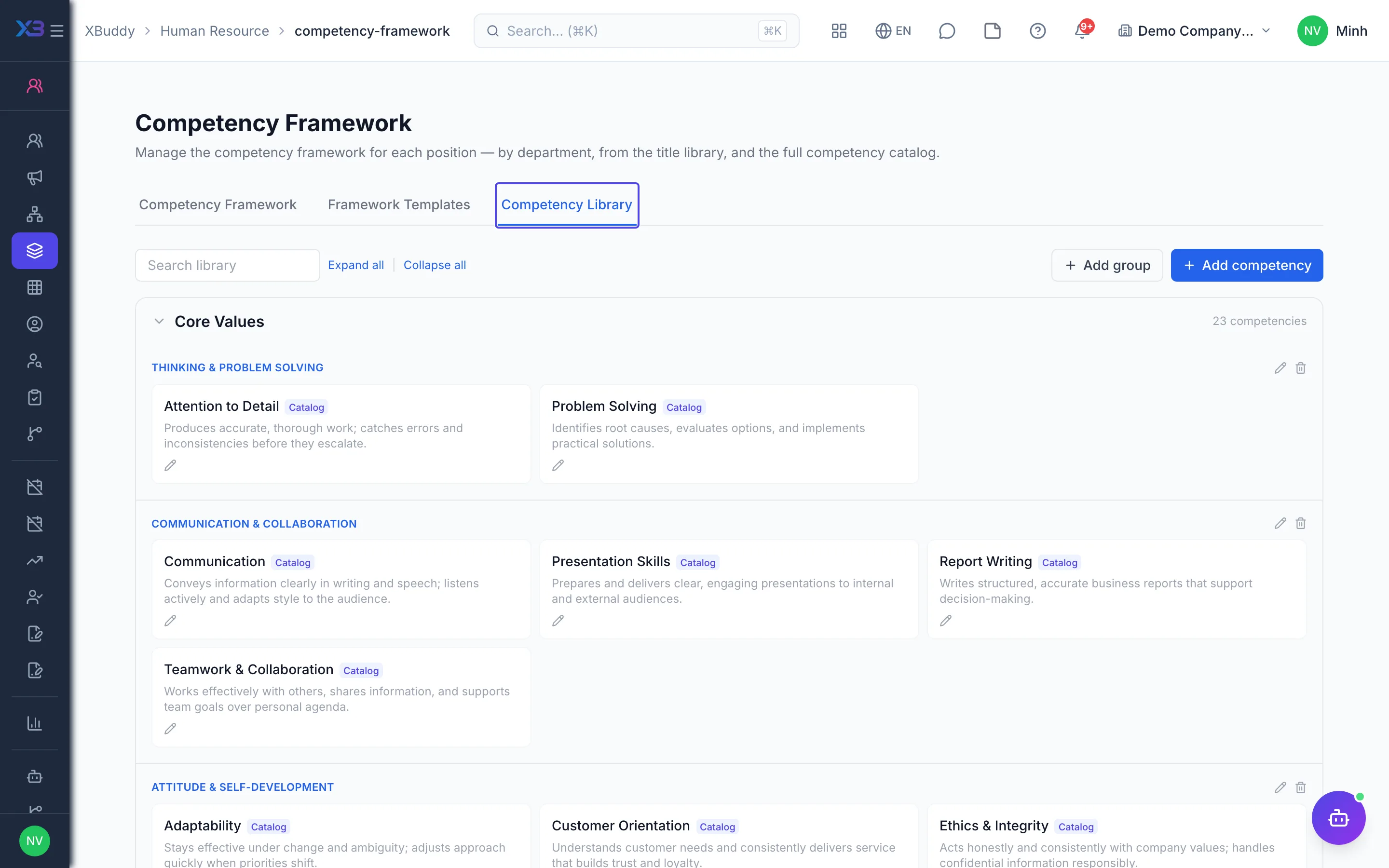
Below are three competencies quoted verbatim from the XBuddy competency template library, one from each of three groups.
Communication (Core)
Conveys information clearly in writing and speech; listens actively and adapts style to the audience.
| Level | Behavioural indicator |
|---|---|
| 1 · Basic | Communicates simple information clearly within the team. |
| 2 · Developing | Structures messages logically; listens and clarifies before responding. |
| 3 · Proficient | Adapts tone and content to different audiences; writes clear business documents. |
| 4 · Advanced | Communicates persuasively with senior stakeholders; handles difficult conversations. |
| 5 · Expert | Represents the company externally; shapes organizational messaging. |
Negotiation (Functional)
| Level | Behavioural indicator |
|---|---|
| 1 · Basic | Handles simple price/term discussions within given limits. |
| 2 · Developing | Prepares negotiation positions and trades small concessions. |
| 3 · Proficient | Negotiates full deals independently with win-win outcomes. |
| 4 · Advanced | Leads complex, multi-party or high-value negotiations. |
| 5 · Expert | Sets negotiation strategy and standards for the organization. |
People Management (Leadership)
| Level | Behavioural indicator |
|---|---|
| 1 · Basic | Coordinates the daily work of a small group. |
| 2 · Developing | Assigns tasks, tracks progress, and gives basic feedback. |
| 3 · Proficient | Manages a full team: goals, reviews, development plans. |
| 4 · Advanced | Manages managers or multiple teams; builds bench strength. |
| 5 · Expert | Shapes organization design and leadership culture. |
Notice three properties of these indicators:
- Each level widens the scope of impact: from within the team, to senior stakeholders, to outside the organisation.
- Each level increases independence: from "with guidance" to "independently" to "leading others".
- Evidence can be found: a negotiation record, a document someone wrote, a successor someone developed.
When writing indicators for your own competencies, use action verbs (structures, diagnoses, leads, sets) and avoid degree adjectives (good, very good, excellent).
Attaching competencies to positions
A competency only means something with a required level for a specific position. For the same "Negotiation" competency, a sales executive needs level 3 and a sales manager needs level 4.
Principles for mapping:
- 5–8 competencies per position: all core competencies, plus 2–4 functional or technical ones, plus leadership competencies for management roles.
- The required level reflects the role, not the person. Write it for a fully competent incumbent, not for your current top performer.
- Separate "required" from "nice to have". A gap in a required competency calls for training now; a gap in a nice-to-have is a development opportunity.
Illustrative example: competency gaps of a sales team lead
Illustrative example with hypothetical figures. The "Sales team lead" position requires:
| Competency | Required | Self | Manager | Peers (avg of 3) | Reports (avg of 4) | Final | Gap |
|---|---|---|---|---|---|---|---|
| Communication | 3 | 4 | 3 | 3.3 | 3.5 | 3 | 0 |
| Customer orientation | 3 | 4 | 4 | 3.7 | — | 4 | +1 |
| Negotiation | 4 | 4 | 3 | 3.0 | — | 3 | −1 |
| People management | 3 | 3 | 2 | — | 2.3 | 2 | −1 |
The 360 results show two gaps: Negotiation (one level short) and People management (one level short). Notably, this person rated their own Negotiation at level 4 while the manager and peers saw level 3. The gap between self-assessment and others' assessment is exactly what the feedback conversation should cover.
The final level is decided by the manager after reviewing all perspectives, not a mechanical average. Here, direct reports rated People management 2.3 with the comment "no regular feedback yet", which matches the step from level 2 to level 3.
From 360 review to individual development plan
A 360 review gathers input from self-assessment, manager, peers and direct reports. To make the results trustworthy:
- Score against indicators, not impressions. The form should show each level's indicator right next to the score field.
- Ask for concrete examples for the highest and lowest scores.
- Include a calibration step to reduce the gap between lenient and strict managers.
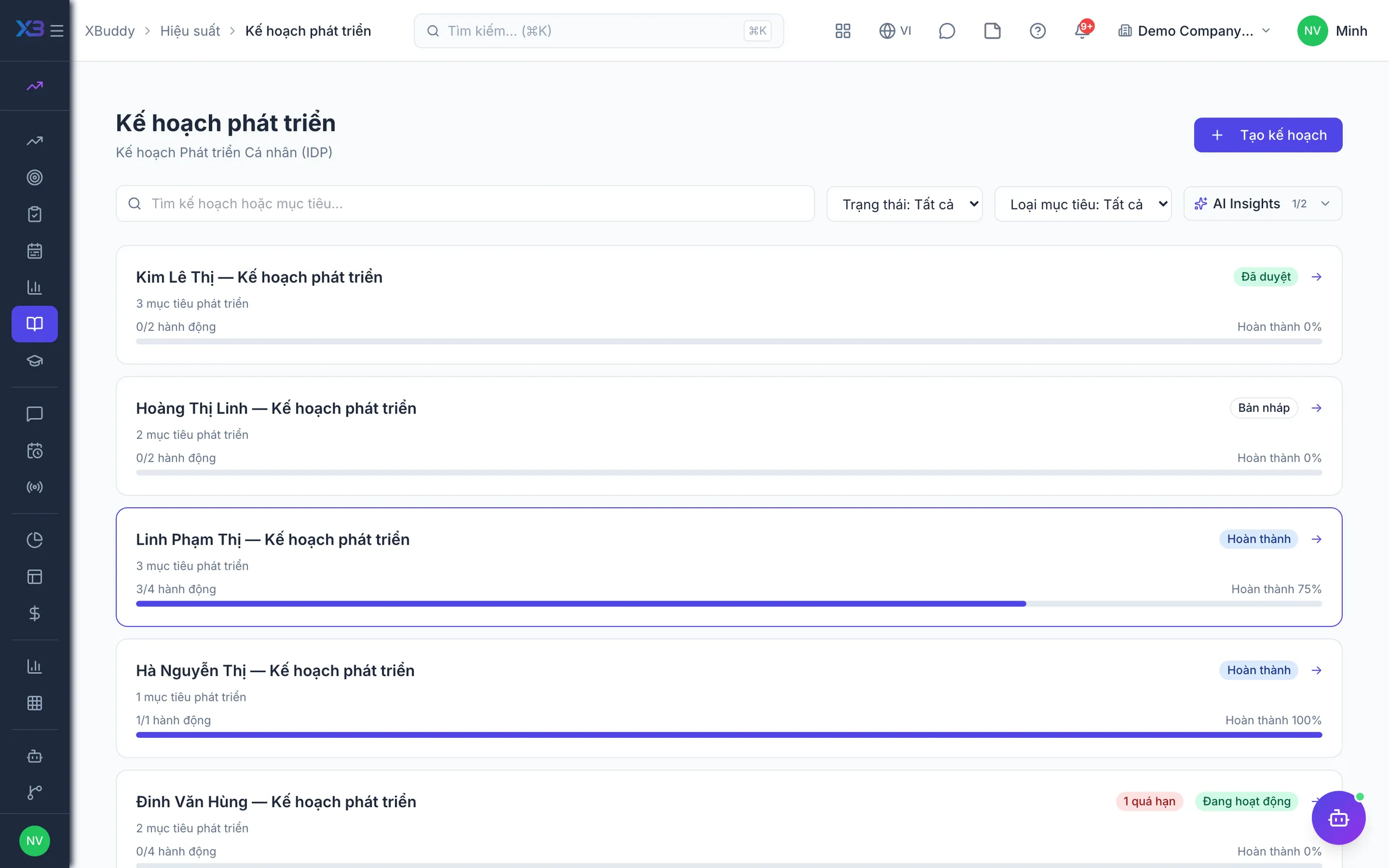
Once finalised, each required gap should become a goal in an individual development plan (IDP) with concrete actions. A ratio often cited is 70-20-10 (learning on the job, from others, from courses). Treat it as guidance, not a mandatory formula. For the example above:
- Negotiation 3 → 4: lead two framework-agreement negotiations with the manager present; attend an advanced negotiation course.
- People management 2 → 3: hold fortnightly one-on-ones with each team member; build a development plan for the whole team this quarter.
Reassess after 6–12 months. Once the new level is recorded, it becomes input for succession planning.
How XBuddy supports this
The XBuddy competency template library contains 108 competencies across core, functional, leadership and technical groups; the most-used ones come with a five-level ladder and behavioural indicators like the examples above. In the HR app you manage competency frameworks by position, a skills matrix and succession plans. The Performance app runs 360 review cycles with calibration, builds IDPs and can suggest courses or coaching programmes for the competencies to develop; when the corresponding toggle is on, competency scores in the manager's review update the employee's competency levels. See also the HR & talent solution.
Frequently asked questions
How many competencies should a competency framework have?
The organisation-wide library can hold several dozen competencies, but each position should carry only 5–8. Core competencies should be few and stable, about 3–6 that apply to everyone.
Why use a five-level scale?
Five levels are detailed enough to separate newcomers, proficient staff and experts, without overwhelming reviewers. More important than the number of levels is that each level has observable behavioural indicators.
How is a behavioural indicator different from a normal level description?
A behavioural indicator describes what the person can do, with evidence findable at work, for example "leads multi-party negotiations". A normal description uses adjectives such as "good negotiator", which each reviewer interprets differently.
Is the final competency level the average of the 360 scores?
It should not be calculated mechanically. 360 scores are input; the manager reviews all perspectives, compares them with the indicators and evidence, then sets the level, which can go through a shared calibration step.
How often should competencies be reassessed?
Usually once a year alongside the performance review, or every six months for roles with an active development plan. Assessing too often leaves people no time to change their behaviour.