
KPI vs OKR: how they differ and how to use them together
KPIs measure the health of what already runs; OKRs bet on change. Learn to tell them apart, pick the right one and link Key Results to auto-measured KPIs.
Ask ten department heads about KPI vs OKR and you will get ten answers, most of them partly right but none precise enough to act on. Some companies drop KPIs to "move to OKRs" and come back six months later because nobody is watching monthly revenue anymore. Others tie OKRs to bonuses and then find that everyone only sets goals they are sure to hit. The two tools do not replace each other. This article explains which question each one answers, when to use which, and how to connect them so the same numbers are never entered twice.
KPI vs OKR: two different questions
A KPI (Key Performance Indicator) answers: "Is the work we already do running well?" KPIs measure recurring, long-lived activity: monthly sales, order count, ticket resolution time, collection rate. A good KPI has a stable definition, a clear direction (higher is better or lower is better) and a threshold that tells you when to step in.
An OKR (Objectives and Key Results) answers: "What do we want to change this cycle?" An Objective is a qualitative destination that is inspiring enough to rally people. Each Objective has a few quantitative Key Results that define what arriving looks like. OKRs are time-boxed: at the end of the quarter or year you score them, learn from them and set a new set.
An easy picture: KPIs are the dashboard of a car, always on and telling you whether the car is running fine. OKRs are the route for this particular trip, with a destination and an end date.
| Criterion | KPI | OKR |
|---|---|---|
| Question | Is the operation healthy? | What must change this cycle? |
| Time frame | Continuous, no end date | Per cycle (quarter, year) |
| Ambition | Realistic, can be committed to | Usually above the "safe" level |
| Who sets it | Mostly top-down, by function | A mix of top-down and bottom-up |
| When off track | Alert, investigate the cause | Adjust initiatives, learn from results |
| Tied to pay | Common | Many organisations deliberately keep them apart |
When to use KPIs and when to use OKRs
Use KPIs for "keep it good"
Every department has work that must happen regularly and must not get worse: accounting closes the books on time, the warehouse keeps stock accurate, customer service responds within the promised window. That work needs KPIs. Without them, you only learn about a problem when a customer complains or at year-end closing.
Signs you need a KPI:
- The activity repeats every period and will continue for years.
- You know what "normal" looks like and want to spot deviations.
- The data can come from operational systems rather than self-reporting.
Use OKRs for "make it different"
When a business wants to enter a new market, shorten its sales cycle, launch a product or change how it operates, existing KPIs are not enough. These changes need a shared destination, communicated from leadership down to each team, and reviewed every week. That is where OKRs belong.
Signs you need an OKR:
- The goal requires several departments to work together.
- Nobody is sure which approach will work, so you need to try and adjust.
- The result matters within a defined period of time.
Three common mistakes
- Turning every KPI into a Key Result. An OKR set with 15 Key Results such as "maintain sales" or "maintain collection rate" is really a renamed KPI sheet. Key Results should describe change, not standing still.
- Tying OKR scores directly to pay. When OKR scores decide income, people set safe goals and OKRs lose the very thing that makes them useful: ambition. Many organisations use KPIs for bonuses and treat OKR results as input for the review conversation.
- Updating progress by hand at the end of each quarter. If nobody looks at Key Results mid-cycle, OKRs become paperwork. Progress needs regular updates, ideally automatic, from real data.
Linking Key Results to auto-measured KPIs
The most effective way to use the two together is to let them share data rather than run side by side.
The principle: when a Key Result measures the same quantity as an existing KPI, link them instead of measuring again. The KPI keeps the definition, data source and direction. The Key Result borrows the KPI's actual value and adds an ambitious target for the cycle. When the KPI updates, the Key Result follows.
Benefits:
- One source of numbers. No more OKR reports saying sales reached 80% while the KPI report says 72%.
- No manual entry. Owners only update their confidence level and notes, not the figures.
- Visible relationships. When a Key Result falls behind, you open the underlying KPI to see where.
Key Results without a matching KPI (for example "launch a customer self-service portal") can be linked to tasks instead: as tasks move to done, Key Result progress rises automatically.
Illustrative example: the sales team of a distributor
Illustrative example with hypothetical figures. An office-equipment distributor has 12 salespeople. For 2026, leadership wants to expand into mid-sized business customers.
Team KPI sheet (tracked monthly, continuously):
| KPI | Definition | Direction | Monthly threshold |
|---|---|---|---|
| Sales order amount | Value of confirmed orders in the period | Higher is better | VND 3.0 billion |
| Sales order count | Number of confirmed orders in the period | Higher is better | 240 orders |
| Average order value | Sales amount divided by order count | Higher is better | VND 12.5 million |
| New leads | Leads created in the period | Higher is better | 150 leads |
Q1 2026 OKR:
Objective: Become the go-to supplier for mid-sized businesses in Ho Chi Minh City.
- KR1: Raise average order value from VND 12.5 million to VND 16 million. Linked to the "Average order value" KPI.
- KR2: Sign 20 framework agreements with companies of 50+ employees. Linked to the contract-signing tasks.
- KR3: 40% of new leads come from the mid-sized segment (start of quarter: 15%).
Suppose that at the end of February the "Average order value" KPI records VND 14.2 million. Because KR1 is linked, its progress is calculated automatically as (14.2 − 12.5) / (16 − 12.5) ≈ 49%; nobody types a number. The sales manager only updates the confidence level and adds a note during the weekly check-in.
At the same time, if the "Sales order count" KPI drops to 200 orders, that signals the day-to-day business is suffering because the team is focusing on large accounts. Leadership sees both pictures: the change under way (OKR) and its cost (KPI).
At quarter end, the OKR score feeds into the review to discuss what was learned. The sales bonus is still calculated from the sales KPI under the published policy.
Putting it into practice: four steps
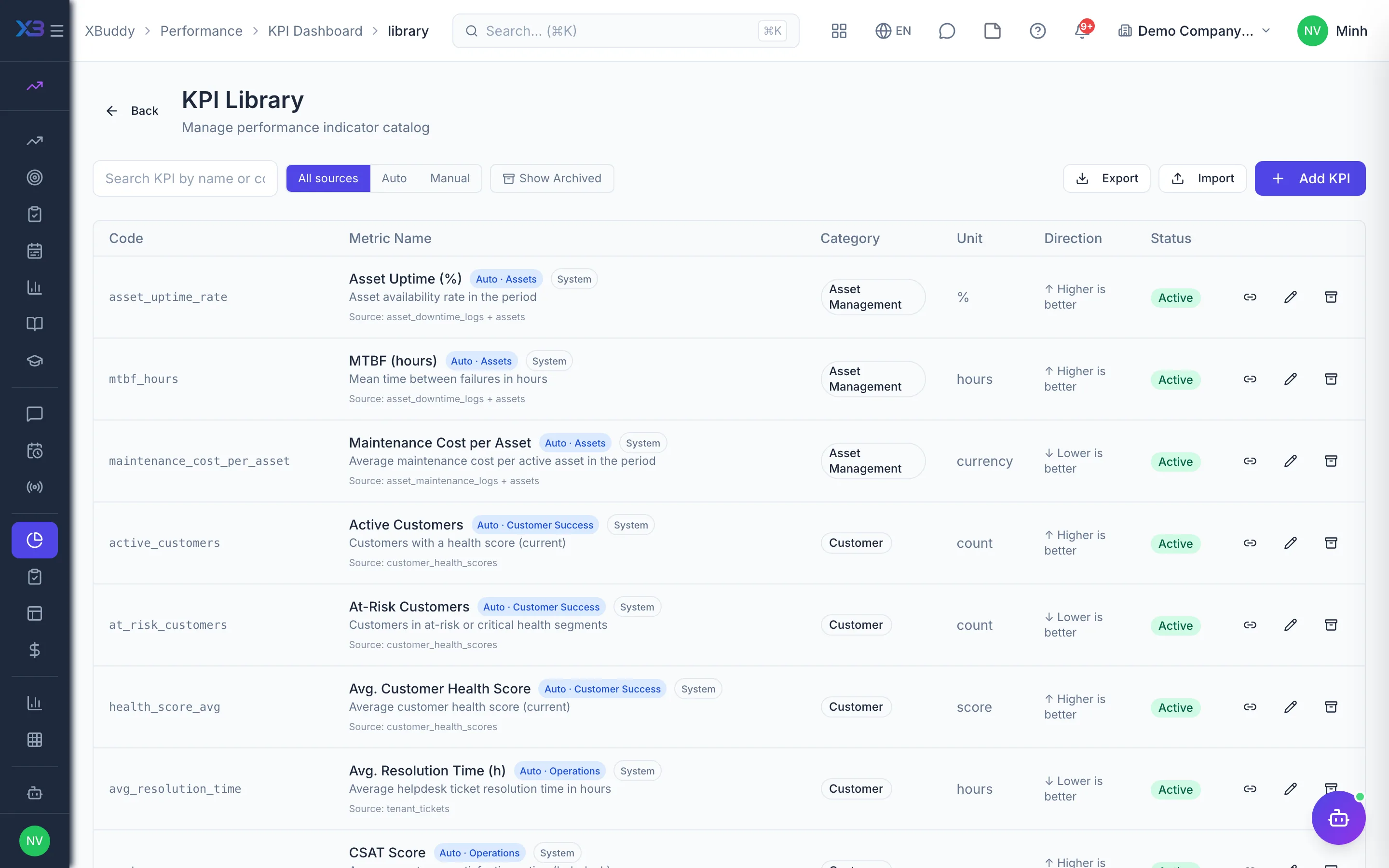
- List KPIs first. Each department picks 4–6 KPIs that reflect operational health, preferring indicators that systems can measure.
- Choose 1–3 company Objectives. Few but clear. Each Objective gets 2–4 Key Results.
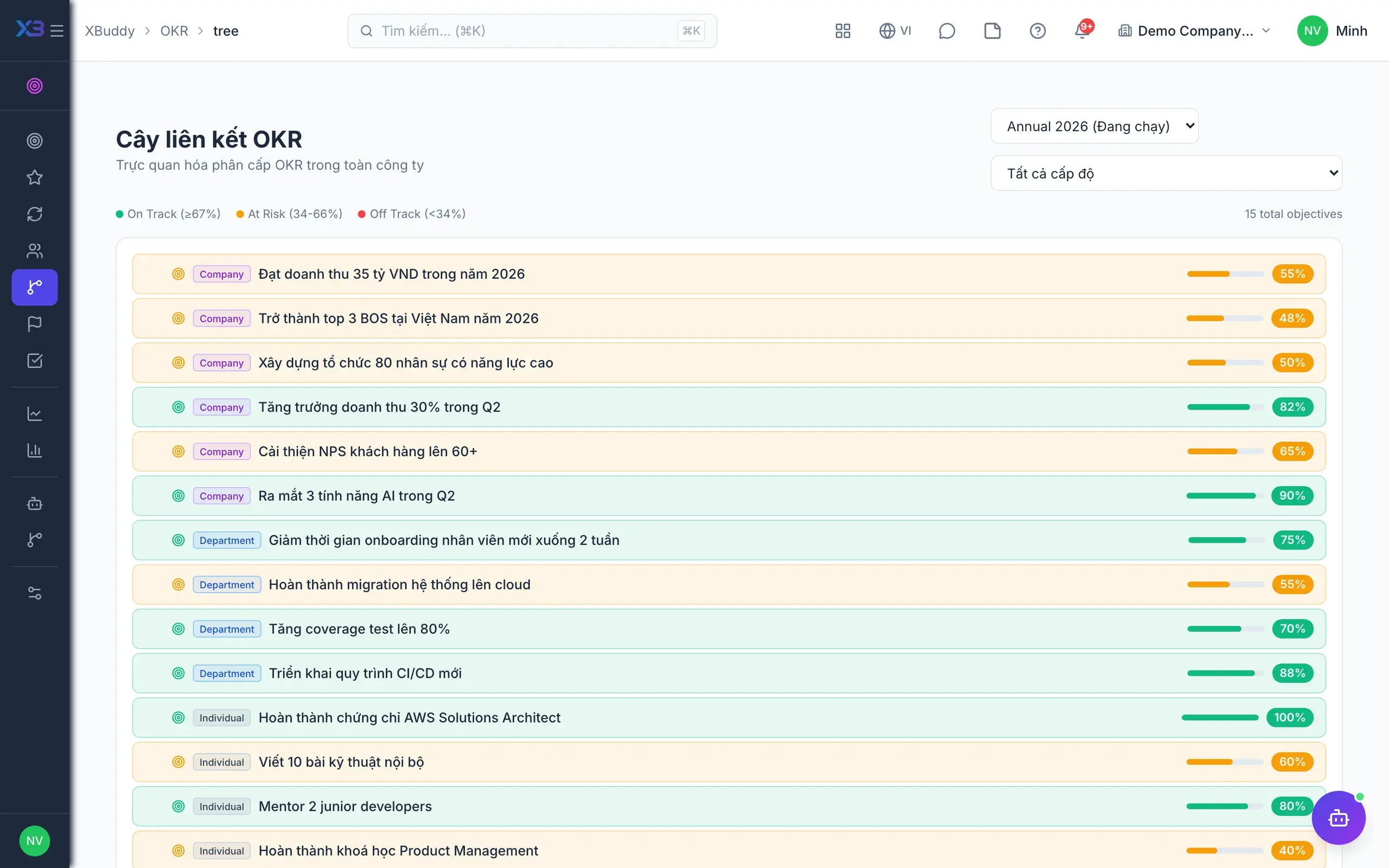
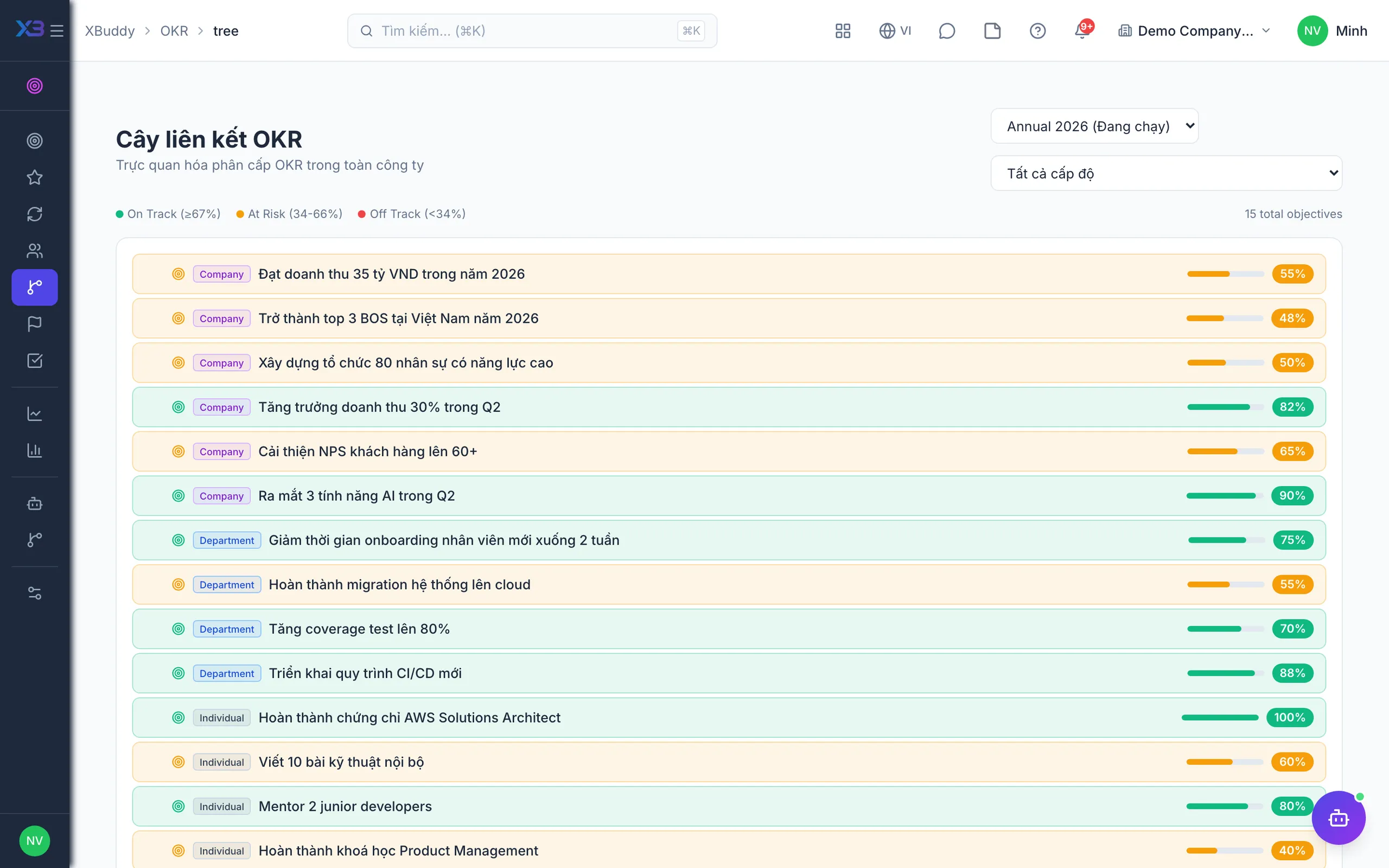
- Cascade to departments and individuals. Team OKRs should contribute to company OKRs, and the alignment tree should be visible.
- Set a weekly check-in rhythm. Fifteen minutes a week to update confidence is worth more than a long meeting at quarter end.
How XBuddy supports this
In XBuddy, the Performance app includes a KPI library with indicators measured automatically from CRM, sales, projects, service, finance and HR. The OKR app lets you link Key Results to KPIs, tasks or courses: when a KPI's actual value updates, linked Key Results sync; when a task changes status, Key Result progress and milestones update too. When a cycle closes, each employee's OKR score is carried into the performance review cycle with an overlapping period. XBuddy deliberately keeps OKRs out of payroll; pay parameters use KPIs or another evaluation method chosen by the business.
The Performance & OKR Coach assistant tracks KPIs that drift from target, forecasts OKR cycle risk and sends check-in reminders. It only alerts and summarises; managers still make the decisions.
Frequently asked questions
Can KPIs and OKRs replace each other?
No. KPIs track the health of recurring activities, while OKRs steer change within a cycle. Companies that drop KPIs in favour of OKRs often lose the ability to notice early when day-to-day operations deteriorate.
Can a Key Result be a KPI?
Yes, when the Key Result measures the same quantity as a KPI but sets a higher target for the cycle. In that case, link the Key Result to the KPI so both use one data source. Still, do not turn every KPI into a Key Result, because Key Results should describe change.
Should OKR scores be tied to bonuses?
Many organisations choose not to tie them directly, because when OKR scores determine income, people tend to set safe goals. A common approach is to use KPIs for bonuses and OKR results as input for the review conversation.
How many OKRs should each person have?
Typically 1–3 Objectives per cycle, each with 2–4 Key Results. Beyond that, focus gets diluted and the weekly check-in becomes a burden.
How often should OKR progress be updated?
Check in weekly, briefly, focusing on confidence and blockers. If Key Results are linked to KPIs or tasks, the figures update automatically and the check-in becomes a conversation.