
Choosing ERP Software for SMEs in Vietnam: 10 Tested Criteria
Every demo looks good. These ten criteria and verification questions help small and mid-sized businesses tell an ERP that lasts from one that only demos well.
Choosing ERP software for small and medium businesses is one of the hardest decisions for an owner to reverse. Once customers, inventory, receivables and the ledger live in one system, moving to another takes months and a great deal of the team's effort. The trouble is that every demo looks good: clean sample data, smooth flows, and the answer is always "yes".
This article sets out 10 criteria, each with a verification question — a question that forces the vendor to show real operations instead of answering in words.
Before the demo: write down three of your own processes
Do not let the vendor run the demo on their script. Prepare your three most painful processes in advance, for example: quotation → sales order → delivery → invoice → collection; purchase request → purchase order → goods receipt → payment; attendance → payroll → posting. Ask them to run exactly those three, with data close to yours.
10 criteria for choosing ERP software
1. Fit with Vietnamese standards and regulations
The chart of accounts, financial statements, VAT returns and e-invoices must follow current rules. In particular, Circular 99/2025/TT-BTC, issued by the Ministry of Finance on 27 October 2025 and effective from 1 January 2026, replaces Circular 200/2014/TT-BTC on the enterprise accounting regime. Companies whose financial year does not follow the calendar year should confirm when it applies to them under Ministry of Finance guidance.
Verification question: "Show me how to select the accounting regime for a company and how the system maps accounts when switching regimes." If the answer is "we will update it", ask how far the update has got.
2. A single source of data
A sales order should generate journal entries, a goods issue should reduce stock, an invoice should update receivables — with no re-keying between departments. If accounting still has to post by hand what sales and the warehouse have already done, you are looking at three products taped together.
Verification question: "Create a sales order, deliver it, invoice it, then open the general ledger and show me the entry just generated and its source document."
3. Granular permissions and segregation of duties
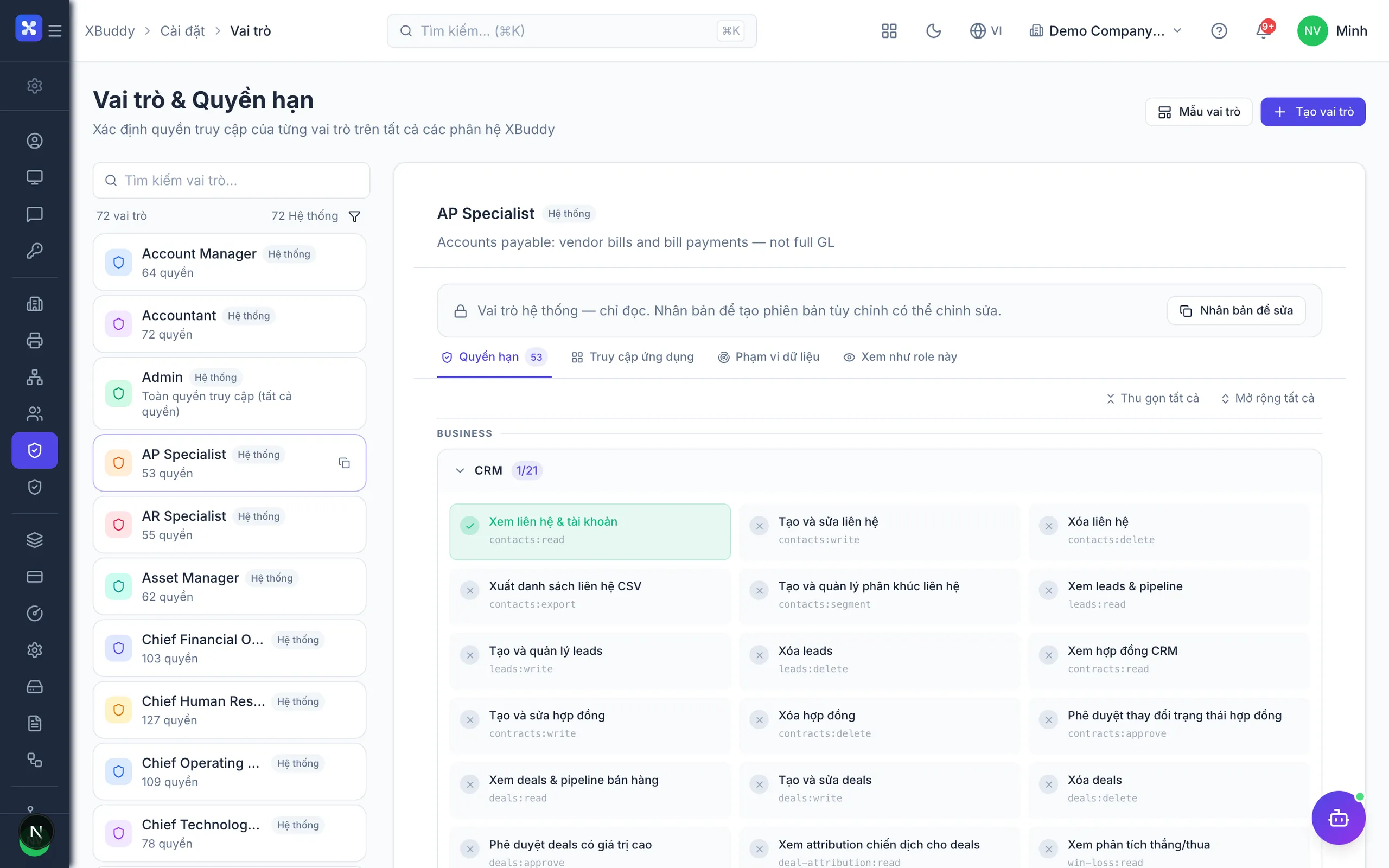
A sales rep sees only their own customers; a team lead sees the team's; the person who prepares a document cannot approve it. Role-based permissions and data scope (mine / team / whole company) are two separate axes, and a good ERP needs both.
Verification question: "Log in as a sales rep and show me the customer list. Then try to approve an order that same person created."
4. Ready-made templates for a fast start
Chart of accounts, role templates, approval workflows, payroll formulas, KPI sets — if everything has to be built from a blank page, the project drags on and depends on the consultant.
Verification question: "Which templates can I use immediately? If I edit a template, will the vendor's next update overwrite my changes?"
5. Structured implementation support
Implementations usually fail not because of the software but because of sequencing: transactions entered before master data is ready, parallel runs before opening balances are agreed. Ask about the method, not only the number of consulting hours.
Verification question: "Show me the implementation steps for one module, from data preparation to the pre-go-live check."
6. Usable on mobile
Field sales reps, technicians and travelling managers need to approve, clock in and look up orders on their phones. Check whether the mobile app is a real app or a shrunken web page, and whether it works on a patchy connection.
Verification question: "Approve a payment request on a phone for me. What happens when the connection drops?"
7. AI under control
AI is useful for reading, explaining, drafting and warning. It is dangerous when it posts entries or emails customers on its own. Ask exactly what the AI may do, who approves it and whether it is logged. See also AI in accounting: what to delegate, what never to delegate.
Verification question: "When the AI proposes a data-changing action, which steps does it go through before it takes effect?"
8. Transparent total cost of ownership
The list price is only part of it. Add up per-user subscriptions, add-on modules, implementation, customisation, storage, integrations, and internal cost (staff time spent learning and entering data).
Verification question: "If I grow from 20 to 50 users and add one module, what will next year's invoice be? Put it in writing."
9. APIs and integrations
Banks, e-invoicing, e-commerce marketplaces, the accounting software you already use — the ERP has to talk to them. Ask about documented APIs, webhooks and integrations already running for other customers.
Verification question: "How does your bank integration behave when the same transaction arrives twice?"
10. Exporting your own data
Data is the company's asset. You must be able to export lists, documents and ledgers to common formats at any time, without asking permission.
Verification question: "If I stop using the product next year, in what format do I get my data, and how quickly?"
Illustrative example: scoring two vendors
The figures below are assumptions used to show how scoring works. A 35-person trading company scores vendors A and B on a 1–5 scale with weights:
| Criterion | Weight | A | B |
|---|---|---|---|
| Vietnamese standards | 15% | 5 | 3 |
| Single data source | 15% | 4 | 5 |
| Permissions | 10% | 4 | 3 |
| Templates | 10% | 4 | 2 |
| Implementation support | 10% | 3 | 4 |
| Mobile | 10% | 4 | 3 |
| Controlled AI | 5% | 4 | 2 |
| Cost | 15% | 3 | 4 |
| API | 5% | 3 | 4 |
| Data export | 5% | 4 | 3 |
| Weighted total | 100% | 3.85 | 3.45 |
A wins despite costing more, because it scores well on the heavily weighted criteria. More important than the result is the process: every score is given after the vendor shows the real operation, not after hearing an answer.
How XBuddy answers these criteria
XBuddy is an operations platform for small and mid-sized businesses where sales, purchasing, inventory, accounting and HR run on the same data. A few points that map directly to the list above:
- Charts of accounts under Vietnamese standards (Circulars 200, 133 and 99), B01/B02/B03/B09 statements and the 01/GTGT VAT return generated from the ledger; templates are available in the Templates library → Chart of accounts.
- Permissions by role and data scope, with role templates for common positions.
- A Setup support tab in each app guides preparation, configuration, data import and pre-go-live checks.
- AI assistants propose and authorised people approve; write actions go through the same permissions as the user interface.
Per-user pricing is published on the Pricing page. If you are planning a rollout, ERP implementation: seven decisions that decide the outcome is the next read.
Frequently asked questions
At what company size should a business adopt ERP?
There is no fixed threshold. Better signals than headcount are the same data being entered in several places, month-end reconciliation taking days, or the owner being unable to see stock and receivables in real time. When these appear, the cost of not having an ERP is usually already higher than the software.
Cloud ERP or on-premises?
For most small and mid-sized businesses, cloud software reduces infrastructure, IT staffing and update costs. On-premises suits specific requirements around data storage or internal connectivity. Whichever you choose, check export and backup capabilities.
Should the ERP be heavily customised to match current processes?
Keep it to a minimum. Heavy customisation raises cost, lengthens the project and makes later upgrades harder. Before asking for customisation, ask whether the current process is actually the best one, and whether the software can be configured rather than modified in code.
How long does an SME ERP implementation usually take?
It depends on the number of modules, the quality of input data and how ready the team is. The way to reduce risk is phased rollout: start with one or two of the most painful modules, agree opening balances, stabilise, then expand. Ask the vendor for a phased plan in writing.
How can I check whether an ERP supports Circular 99/2025?
Ask the vendor to show it live: selecting the accounting regime for a company, the matching chart of accounts, how balances move from old accounts to new ones, and the financial statement templates. Compare against the Ministry of Finance's original text, or have your chief accountant check the main changes.