
Circular 99/2025/TT-BTC: how businesses should prepare
Circular 99/2025/TT-BTC replaces Circular 200 from 1 January 2026. Here are the points we could verify, plus a practical checklist for converting the chart of accounts and financial statements.
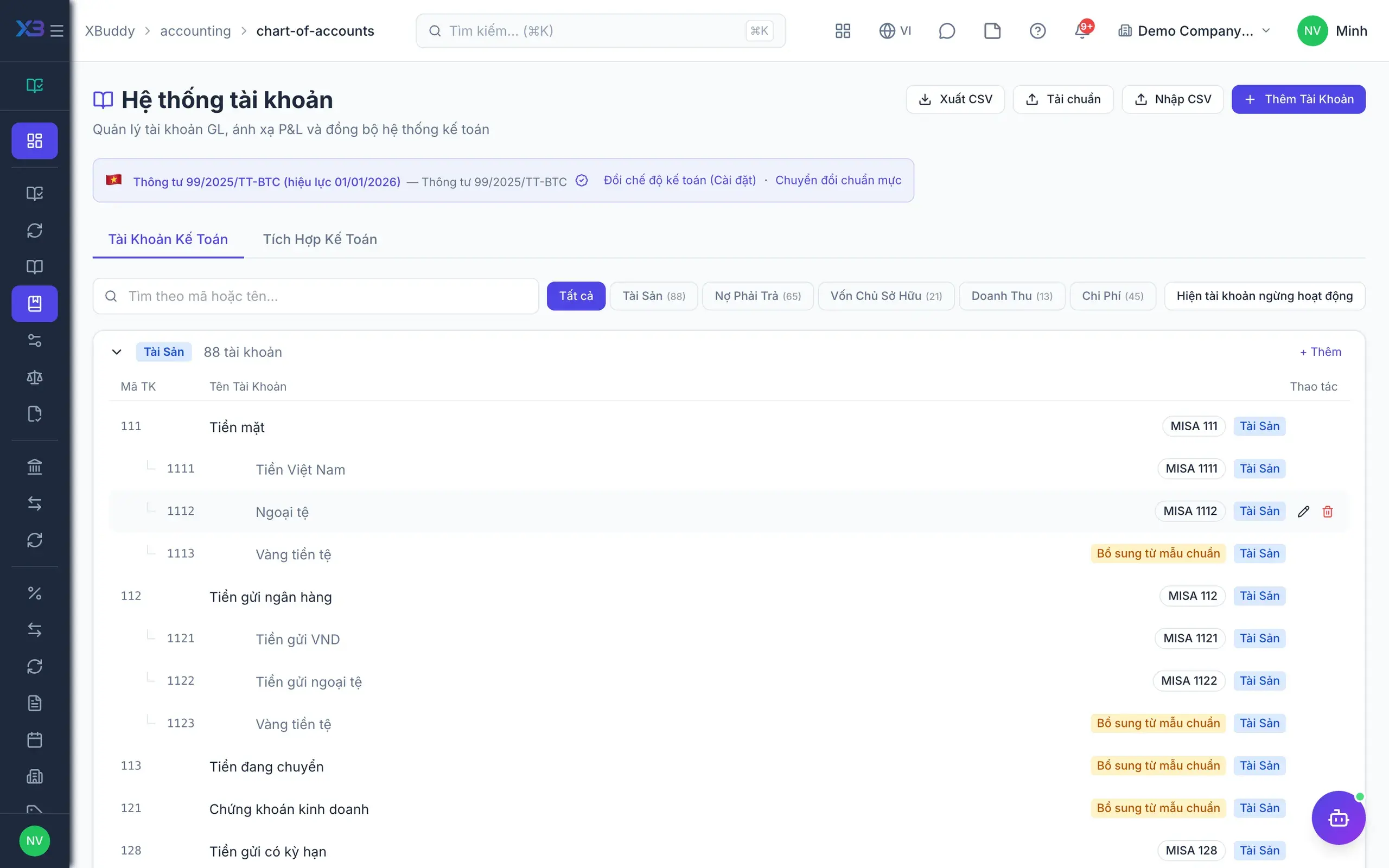
Circular 99/2025/TT-BTC sets out the enterprise accounting regime in Vietnam. The Ministry of Finance issued it on 27 October 2025; it took effect on 1 January 2026 and replaces Circular 200/2014/TT-BTC. For most companies whose fiscal year follows the calendar year, 2026 is the first year of bookkeeping and reporting under Circular 99/2025. This article summarises the points we could verify against official and reputable advisory sources, then gives a concrete preparation checklist for the finance team.
One caveat up front: we only state points we could verify. For your specific situation, read the circular and its appendices in full, especially the transitional provisions.
Who Circular 99/2025 applies to, and from when
Scope. Circular 99/2025/TT-BTC applies to enterprises in all sectors and all economic sectors. Credit institutions and foreign bank branches follow the separate accounting rules issued under State Bank of Vietnam guidance.
Effective date. The circular took effect on 1 January 2026 and applies to fiscal years beginning on or after 1 January 2026.
Non-calendar fiscal years. In an answer published on the Ministry of Finance Q&A portal, the ministry explained that a company whose fiscal year runs from 1 October 2025 to 30 September 2026 does not apply Circular 99 as of 1 January 2026; it applies from the following fiscal year, starting 1 October 2026. If your fiscal year is offset like this, put that date in your plan.
What it replaces. Circular 99 replaces Circular 200/2014/TT-BTC together with certain related amending circulars. Companies on the small and medium enterprise accounting regime should check the guidance specific to that regime; this article does not cover it.
The main changes we could verify
Chart of accounts
According to KPMG Vietnam's summary of Circular 99:
- Removed: accounts 161, 441, 611 and 631.
- Added: account 215 (biological assets), account 332 (dividends and profits payable) and account 82112 (supplementary corporate income tax expense under the global minimum tax rules).
- Renamed: account 112 changes from "Bank deposits" to "Demand deposits".
- Enterprises may adjust account names, numbers, structure and content to fit their operations, but must issue an internal accounting policy regulation documenting those adjustments.
The last point matters more than it looks: flexibility comes with a documentation duty. A home-made chart of accounts with no written rationale is hard to defend in an audit.
Financial statements
- The balance sheet is renamed the Statement of Financial Position.
- Prescribed forms must be used; enterprises may add line items and disclosures, under the same documentation requirement.
- The current versus non-current classification of assets and liabilities is clarified, with more detailed disclosure for items beyond 12 months.
- Mandatory disclosures expand to significant items such as restricted cash, biological assets, business cooperation contracts, dividends payable, bonds issued, and any item that makes up 10% or more of the related line on the statement.
Accounting policies
- A standard cost method is introduced for inventory costing; the perpetual and periodic inventory concepts are no longer presented as before.
- Periodic repair and maintenance costs are no longer accrued in advance; they are amortised after they are incurred. Companies already accruing major repair costs must stop if the repair has not started by the effective date.
- Provisions for doubtful receivables are set as a percentage by ageing group, with other methods allowed where more appropriate.
- Detailed guidance is added for biological assets and business cooperation contracts.
Accounting currency, documents and internal control
- The default accounting currency is the Vietnamese dong. A company that transacts mainly in a foreign currency may choose it if it meets the stated criteria, and may not change back unless its operations change significantly. Financial statements prepared in a foreign currency must be translated into VND for public disclosure and filing.
- Enterprises may design their own voucher and ledger templates; detailed format rules (ink colour, number of copies) are removed.
- The circular emphasises governance and internal control, and requires accounting software to ensure the accuracy and integrity of data.
Moving balances: follow the transitional provisions, don't improvise
Changes in accounting policy follow the circular's transitional provisions; where the circular is silent, Vietnamese Accounting Standard 29 (VAS 29) applies. In practice, moving balances has three parts:
- Removed accounts (for example 161, 441, 611, 631): determine the year-end 2025 balance and the receiving account under the transitional guidance.
- Renamed or redefined accounts: check that the current balance still fits the new definition. Account 112 now means demand deposits, so any term deposits booked there need review.
- Your own sub-accounts: every sub-account you opened under Circular 200 needs a home in the new chart and an entry in your accounting policy regulation.
Illustrative example
The figures below are hypothetical and only illustrate how to plan. A trading company has 260 accounts in use, including 41 self-created sub-accounts and 3 accounts on the removed list. The team builds a three-column mapping table: old account, new account, basis (transitional provision or internal regulation). They split the work over four weeks:
| Week | Task | Output |
|---|---|---|
| 1 | List all 260 accounts, flag the 3 removed accounts and account 112 | Work list |
| 2 | Map the 41 sub-accounts, draft the accounting policy regulation | Approved mapping table |
| 3 | Dry-run the balance migration on a copy of the data, compare the trial balance before and after | Zero difference, or every line explained |
| 4 | Lock the 2026 opening balances, close the 2025 period | Opening balances signed off by the chief accountant |
The control rule: total debits and total credits on the trial balance before and after the move must match. If they don't, stop and find the line that causes the difference rather than adjusting the totals.
Preparation checklist for the finance team
- Confirm the first year of application for each legal entity, based on its fiscal year.
- Read the full text of Circular 99 and the appendices for the chart of accounts and report templates.
- Build a mapping table from old to new accounts, with a basis column.
- Draft the accounting policy regulation for every change in account name, number or structure.
- Review affected policies: accrual of major repairs, doubtful debt provisions, inventory costing method.
- Dry-run the balance migration on a copy and compare debit and credit totals.
- Update report templates to the Statement of Financial Position and the new disclosure set.
- Review internal controls: who may edit the chart of accounts, who approves journal entries, who closes periods.
- Tell other departments that select account codes on documents (purchasing, inventory, payroll) if their codes change.
What your accounting software should support
When assessing software for the first year under Circular 99, four questions are worth asking:
- Can the accounting regime be set per company? A group with several entities and different fiscal years needs one regime per company.
- Can the conversion be previewed and undone? Converting a chart of accounts is risky; a preview shows which accounts change and which balances move before anything is posted.
- Are account codes data or hard-coded? If the software hard-codes account codes into posting logic, every adjustment in your policy regulation becomes a software change.
- Do reports export in the new format? Report names, line items and disclosures must follow the current templates.
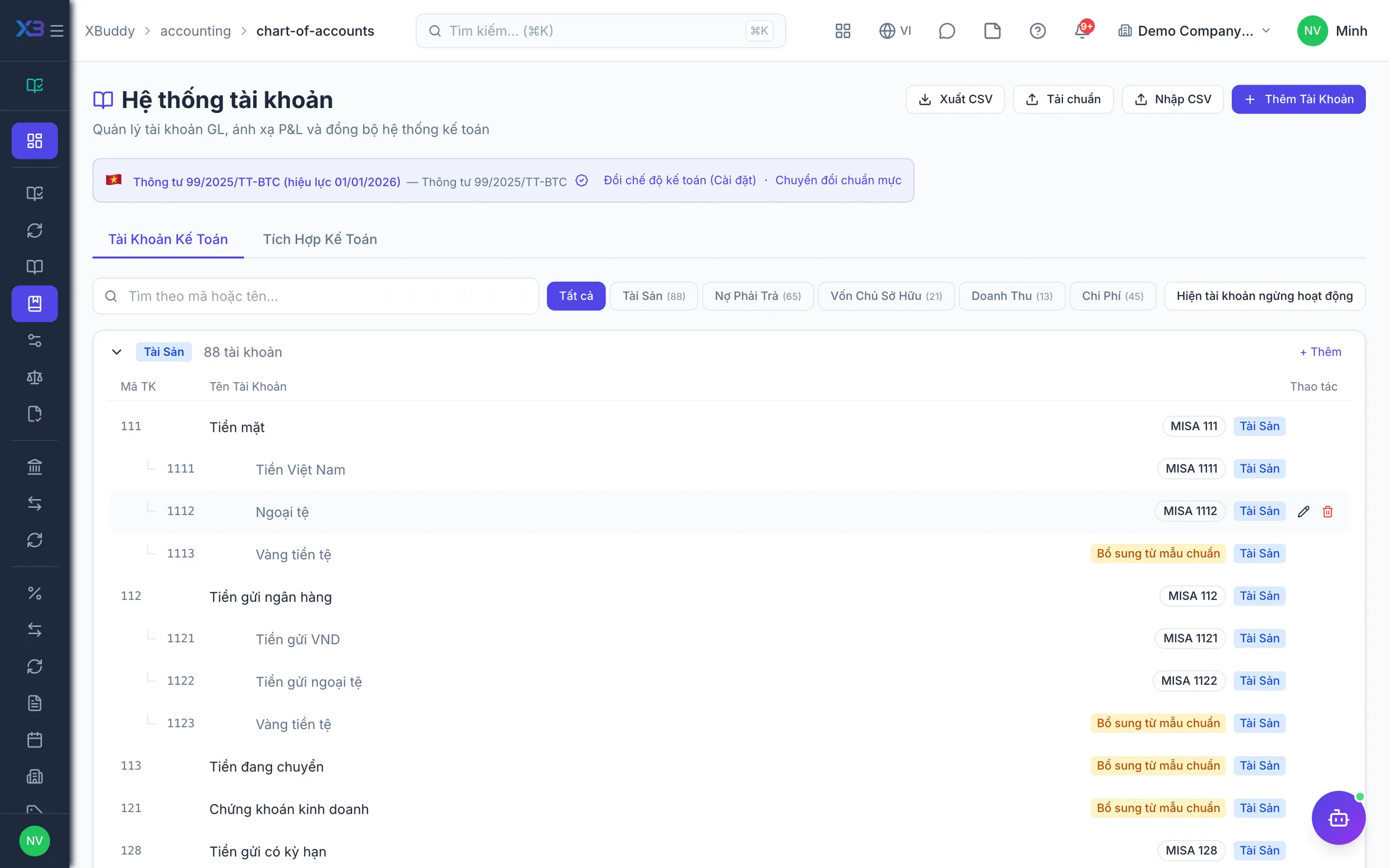
In the XBuddy Accounting app, the accounting regime is set per company (Circular 200, Circular 133 or Circular 99), and a standard conversion tool, for example from Circular 200 to Circular 99, comes with preview, confirmation and undo steps. A sample chart of accounts is available in the template library for comparison before loading. For chief accountants, the Chief Accountant solution shows how this fits with period close and reporting. Whatever software you use, the mapping table and the policy regulation remain human work; software only helps apply them consistently.
If you are considering AI for this review, see AI must never do the arithmetic: AI can point out unusual accounts, but balances and entries must be computed by the system and approved by people.
Frequently asked questions
When does Circular 99/2025/TT-BTC take effect?
Circular 99/2025/TT-BTC was issued on 27 October 2025 and took effect on 1 January 2026. It applies to fiscal years beginning on or after 1 January 2026, so companies whose fiscal year follows the calendar year apply it from 2026.
My fiscal year starts on 1 October. When do I apply it?
According to an answer on the Ministry of Finance Q&A portal, a company with a fiscal year from 1 October 2025 to 30 September 2026 does not apply Circular 99 as of 1 January 2026. It applies from the next fiscal year, starting 1 October 2026.
Which accounts does Circular 99 remove and add?
According to KPMG Vietnam's summary, Circular 99 removes accounts 161, 441, 611 and 631; adds accounts 215, 332 and 82112; and renames account 112 to "Demand deposits". Check the circular's chart of accounts appendix before building your mapping table.
Can a company modify its own chart of accounts?
Yes. Enterprises may adjust account names, numbers, structure and content to fit their operations, but must issue an accounting policy regulation documenting the changes. Without that document, the adjustments are hard to justify in an audit or inspection.
How do I move balances from Circular 200 to Circular 99?
Follow the transitional provisions of Circular 99; where they are silent, apply Vietnamese Accounting Standard 29. Run a dry run on a copy of the data and check that total debits and credits on the trial balance match before and after the conversion.