
Procure-to-Pay and the Three-Way Match: PO, Receipt, Invoice
A disciplined procurement process stops you paying for goods you never received or prices you never agreed. This guide walks through each P2P step and how to run a three-way match, set tolerances and resolve exceptions.
A loose procurement process rarely causes one big incident. It causes hundreds of small discrepancies: paying for 100 cartons when the warehouse received 96, accepting a unit price a few percent above the agreed one, or paying the same invoice twice. Each is minor, but over a year they add up to a meaningful sum — and almost nobody notices without controls. This article covers the procure-to-pay (P2P) cycle and its core control: the three-way match between purchase order, goods receipt and supplier invoice.
What the procure-to-pay process involves
The full cycle has six steps. Smaller businesses can merge or skip some, but it is worth understanding each step's purpose before deciding to drop it.
| Step | Document | Question answered | Typical owner |
|---|---|---|---|
| 1. Request | Purchase Requisition (PR) | Who needs what, when and why? | Requesting department |
| 2. Quote | Request for Quotation (RFQ) | Which supplier offers the best terms? | Purchasing |
| 3. Order | Purchase Order (PO) | What, how many, at what price, delivered when? | Purchasing, approver |
| 4. Receive | Goods Receipt Note (GRN) or service confirmation | How much actually arrived, and in what condition? | Warehouse, requesting department |
| 5. Record invoice | Supplier invoice (Bill) | How much is the supplier charging? | Accounts payable |
| 6. Pay | Payment voucher, bank transfer | How much to pay, and when? | Accounting, cashier |
The most important principle is segregation of duties: the person who places the order should not also confirm receipt and approve payment. When one person controls all three, every downstream check becomes a formality.
Steps 1–2: requisition and quotation
A requisition separates need from buying decision. Engineering knows which part it needs; purchasing knows where to buy it and at what price. An approved requisition is also the first point where off-budget spending can be stopped.
RFQs are worth the effort for large purchases or first-time items. For repeat purchases under a signed price list, you can go straight from requisition to purchase order.
Step 3: the purchase order is a small contract
The PO states items, quantities, unit prices, tax, delivery and payment terms. It is the reference for every later comparison, so any change in price or quantity must be made on the PO and re-approved — not agreed verbally and left for the invoice to reflect.
Step 4: receiving means actually counting
The goods receipt records the quantity actually received, not a copy of the PO quantity. Short deliveries are recorded as short; damaged goods are recorded separately or returned to the supplier. For services (maintenance, consulting, outsourcing) there is no goods receipt, so a service confirmation by the requesting department plays the equivalent role.
What a three-way match is
A three-way match compares three documents produced by three different parties before payment is accepted:
- PO — what was agreed (raised by purchasing, approved).
- Goods receipt — what was actually received (raised by the warehouse).
- Supplier invoice — what is being charged (issued by the supplier, recorded by accounting).
Three questions are answered on every line:
- Quantity: does the invoiced quantity exceed the quantity received?
- Unit price: does the invoice price match the PO price?
- Total: after tax and discounts, is the total reasonable against the PO?
A two-way match (PO against invoice only) suits services or small amounts, but it cannot catch payment for goods that were never delivered. That is why the three-way match is the standard for stocked goods.
Tolerances: when a variance is acceptable
Demanding an exact match to the last cent leaves hundreds of invoices on hold over rounding differences or small freight charges. Businesses therefore set tolerances, usually on two criteria:
- A percentage variance against the PO value.
- An absolute amount of variance.
The two can be combined with "and" (only a variance when both thresholds are exceeded — more lenient) or "or" (exceeding either is a variance — stricter). "And" suits businesses with many small invoices; "or" suits high-value orders where every unit of currency deserves a look.
One principle worth keeping: tolerance applies to price, not to billing above the quantity received. Charging for more than was received is an error to resolve, not a rounding difference.
Illustrative example: an invoice off on both price and quantity
Illustrative example with assumed figures. A company orders 100 cartons of paint at VND 250,000 each, a PO total of VND 25,000,000 before tax. Tolerance policy: a price variance is flagged when it exceeds 1% and VND 200,000.
- Goods receipt: the warehouse counts 96 cartons; the supplier will deliver the remaining 4 next week.
- Invoice: the supplier bills 100 cartons at VND 255,000, totalling VND 25,500,000.
Matching:
- Quantity: 100 billed, 96 received → quantity variance of 4 cartons. Not covered by tolerance.
- Unit price: VND 5,000 higher per carton, i.e. 2% above the PO. On the 96 cartons received, the excess is VND 480,000. It exceeds both 1% and VND 200,000 → price variance.
Outcome: the invoice is flagged as an exception and excluded from the payment run. Accounts payable has three valid options: ask the supplier to correct the invoice to the received quantity and PO price; wait for the balance delivery and re-match the quantity; or, if the new price has been accepted, amend the PO through approval before accepting the invoice. The invalid option is to pay the full VND 25,500,000 "to get it done" and leave a note.
Resolving variances: four typical situations
| Situation | Common cause | Resolution |
|---|---|---|
| Invoice bills more than received | Short or partial delivery | Wait for full receipt or request an invoice correction |
| Unit price above the PO | Supplier price increase, outdated PO | Verify; if accepted, amend the PO with approval |
| Goods received, no invoice yet | Invoice arrives late | Track received-not-invoiced items at period close |
| Received goods are defective | Quality | Raise a supplier return; accept the invoice only for good items |
The third situation is often forgotten: goods are in the warehouse but the invoice has not arrived by period end. Without tracking, that period's costs and payables are understated. The list of receipts without invoices belongs on the month-end close checklist.
Where to run the match
A spreadsheet match every Friday is better than nothing, but it runs after money may already have left. Effective control runs the match at the moment the invoice is recorded and ties the result to the payment gate: an invoice in exception does not enter the payment run. The payment approver no longer has to remember to check; the system simply never puts the variance in front of them.
Alongside this come approval limits by amount for both POs and payments (see approval limits and delegation), and a disciplined starting point for demand, such as reorder proposals based on reorder points and safety stock.
How XBuddy supports this
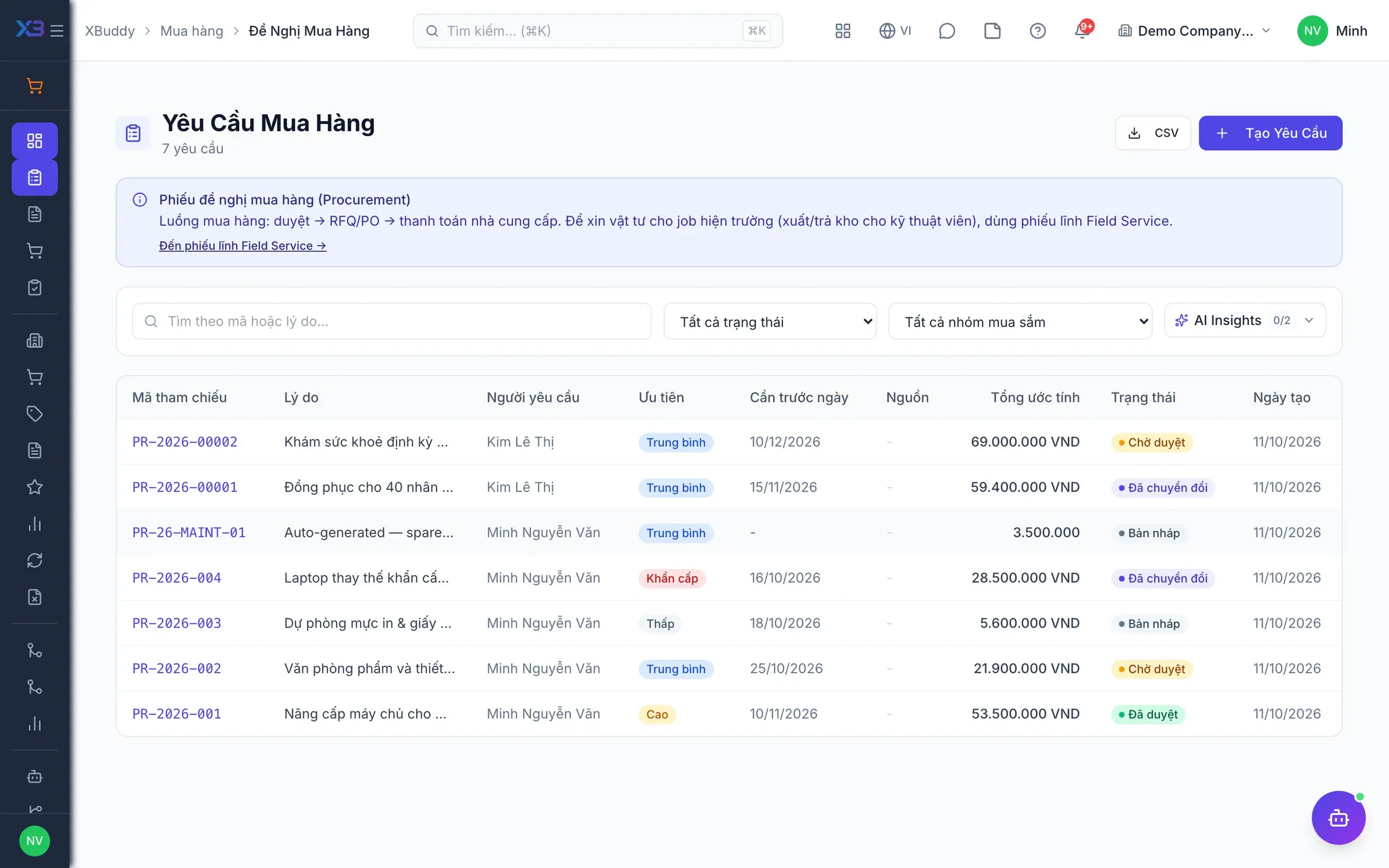
XBuddy's Purchasing app links Purchase Requisition, RFQ, Purchase Order, goods receipt, service confirmation and supplier bill into one document chain that carries quantities forward. Requisitions and RFQs are optional; smaller businesses can create a PO directly. The purchase order list shows each PO's status from draft and pending approval through approved, partially received and received.
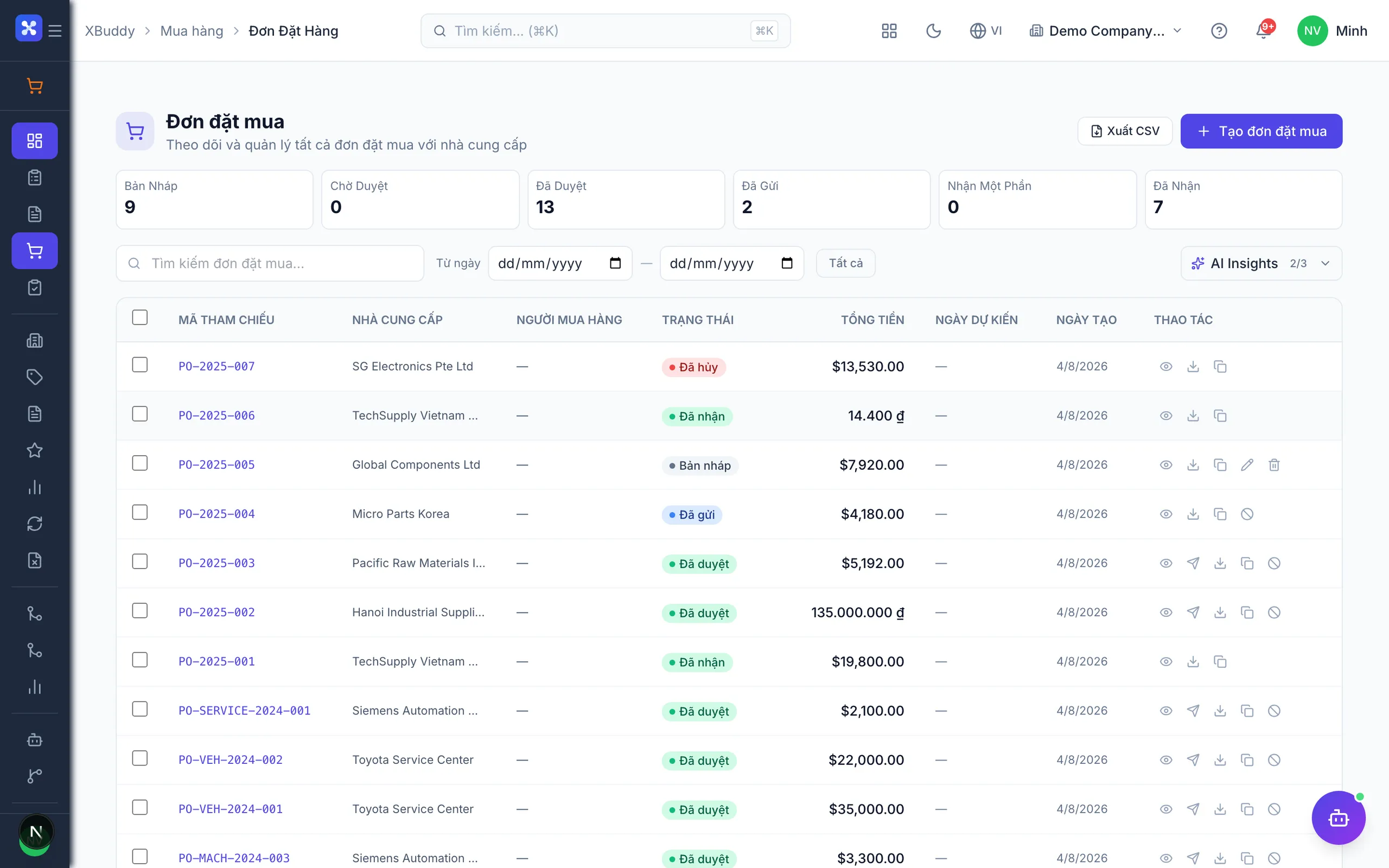
The PO – receipt – invoice three-way match is a configuration toggle. Tolerances are set as a percentage and an amount, combined with "and" or "or", and every matching path reads the same configuration. With the optional block-payment-on-exception setting, a mismatched invoice cannot move on to payment. Businesses that want the full cycle can look at the Procure-to-Pay solution; the Procurement Assistant helps review and suggest, while the decision stays with the approver.
Frequently asked questions
Does a small business need all six P2P steps?
Not necessarily. A small business can skip RFQs for repeat purchases and even create POs directly without a requisition. The steps not to skip are counting goods on receipt and matching before payment, because that is where money for undelivered goods is stopped.
What is the difference between a two-way and a three-way match?
A two-way match compares only the PO and the invoice, checking ordered price and quantity. A three-way match adds the goods receipt, so it catches suppliers billing for goods not yet delivered or delivered short. Services typically use an acceptance confirmation in place of the goods receipt.
What tolerance should we set?
There is no universal level. Tolerance should be wide enough to ignore rounding differences and narrow enough that every meaningful variance gets reviewed. A practical approach is to start tight, monitor how many invoices go on hold over a few months, then adjust — and always record why the setting changed.
When an invoice doesn't match, should we edit the goods receipt to fit?
No. The goods receipt reflects what was actually received and is independent evidence; editing it to match the invoice defeats the purpose of matching. What needs adjusting is the invoice (through the supplier) or the PO (through approval, if a new price has been accepted).
How do we handle goods received without an invoice at period close?
List goods receipts without invoices as at the period-end date and treat them according to your accounting policy so that the period's costs and payables are not understated. Review this list regularly, because receipts that stay open for a long time often signal a dispute or a lost invoice.