
Spending Approval Limits: Designing the Matrix and Delegation
Approval limits by amount let small spend move quickly while large spend gets a closer look. This guide covers designing the threshold matrix, keeping preparers from approving their own items and time-bound delegation during absences.
In many growing businesses, every payment — from a few-million-dong electricity bill to a multi-billion equipment contract — waits for a single person's signature. Small items get stuck, and large items get no closer scrutiny because the approver signs far too much. Approval limits by amount fix both problems at once: small spend is decided at the nearest level, large spend passes through additional control levels. This article covers how to design the threshold matrix, three controls you should not drop, and how to delegate when an approver is away.
What approval limits by amount are
An approval matrix is a table that answers: for this type of spend, at this amount, who must approve? Each row is a value band and each column an approval level. An item passes through every level that applies to its band.
A good matrix has four characteristics:
- Clear, non-overlapping thresholds. Every amount falls into exactly one band; boundaries read "from … to below …".
- Defined by role, not by name. Write "Chief Accountant", not a person's name. When people change, the matrix does not need rewriting.
- Differentiated by spend type. Purchase orders, supplier payments, employee reimbursements and cash advances carry different risks and may warrant different thresholds.
- A final approver for every band. No band may be left without an approver; an item nobody can approve either hangs forever or gets pushed through a shortcut.
Example matrix for a small or mid-sized business
| Value (converted to VND) | Department head | Chief Accountant | CFO | CEO |
|---|---|---|---|---|
| Below 5 million | ✓ | |||
| 5 million – below 50 million | ✓ | ✓ | ||
| 50 million – below 200 million | ✓ | ✓ | ✓ | |
| 200 million and above | ✓ | ✓ | ✓ | ✓ |
This is a reference structure, not a standard. The actual amounts depend on each business's size, margins and risk appetite, as well as its charter and internal financial regulations.
Three controls you should not drop
1. Thresholds in the company's base currency
Businesses with foreign-currency transactions often make a subtle mistake: comparing the document amount against the threshold without converting it. An invoice for USD 3,000 has a "number" far smaller than 5,000,000, and if the system compares them directly it drops to the lowest approval level. The correct rule is that every threshold is stated in the company's base currency and compared with the amount converted at the document's exchange rate.
2. Preparers do not approve their own items
Segregation of duties is the foundation of internal control: the person who creates a spend item must not be the one who approves it. The rule has to apply everywhere an Approve button exists: the approval inbox, the document detail page, the mobile app, bulk approval and also when an item is routed to a delegate. One forgotten place is a bypass.
Very small businesses sometimes have one person who both prepares and approves. If that rule must be relaxed, relaxing it should be a deliberate decision, applied uniformly and leaving a trace — not an accidental gap on one screen.
3. No splitting to stay under a threshold
Splitting a VND 180 million purchase into four orders of 45 million is the classic way around a threshold. Preventive measures include a written policy that splitting is a violation; periodic review of items from the same supplier and preparer within a short period; and, for purchasing, linking orders to a requisition or budget line so the total stays visible.
Illustrative example: a foreign-currency invoice through the matrix
Illustrative example with assumed figures and exchange rate. Using the matrix above, a buyer records an invoice from an overseas supplier for USD 3,000, with a document exchange rate of VND 25,400 per USD.
- Convert: 3,000 × 25,400 = VND 76,200,000.
- Find the band: 76.2 million falls in "50 million – below 200 million".
- Approval chain: Department head → Chief Accountant → CFO.
- Segregation check: the preparer is the buyer, who is not in the chain; valid. Had the department head prepared the invoice, the first level would have to go to another authorised person under the policy, not be self-approved.
Had the system compared 3,000 directly with the 5,000,000 threshold, the invoice would have needed only the department head — skipping two control levels on an item worth over VND 76 million.
Delegation when an approver is away
Approvers travel, take leave or fall ill. Without a delegation mechanism, businesses end up in one of two bad situations: items wait for a week, or the approver shares their login with a subordinate to "approve on their behalf". The second is far worse because the audit trail records the wrong decision-maker.
A sound delegation mechanism needs six elements:
- A time limit. Clear start and end dates. When it expires, authority is revoked automatically, without relying on anyone's memory.
- A scope. Which item types are delegated: only leave requests, only payments, or everything. "Everything" should be reserved for short periods.
- A delegate with matching authority. Do not delegate approval of a 200-million item to someone the policy only allows to approve up to 50 million, unless the policy explicitly permits it.
- No delegation to the preparer. A delegate must not approve items they created; segregation of duties still applies in full.
- An audit trail naming both people. Who approved, on whose behalf, under which delegation. In an audit, "who decided" must be answerable immediately.
- Notifications at start and end. The delegate needs to know they hold authority; the delegator needs to know when it has returned.
A good practice is to tie delegation to the leave or travel request itself: when the request is approved, delegation is created for exactly the absence period, instead of relying on the absent person to remember to set it up.
Rollout: where to start
- Analyse 6–12 months of spend by type and value band. The distribution shows where to set thresholds so most small items move fast while most value still reaches senior levels.
- Write the matrix by role, approved by management and issued as an internal policy.
- Configure it in the system rather than only issuing it on paper; test with a few sample documents in each band, including foreign-currency ones.
- Set up delegation templates for common situations (annual leave, business travel, emergencies).
- Review regularly: approval turnaround, returned items and delegation activity, and adjust thresholds as the business grows.
How XBuddy supports this
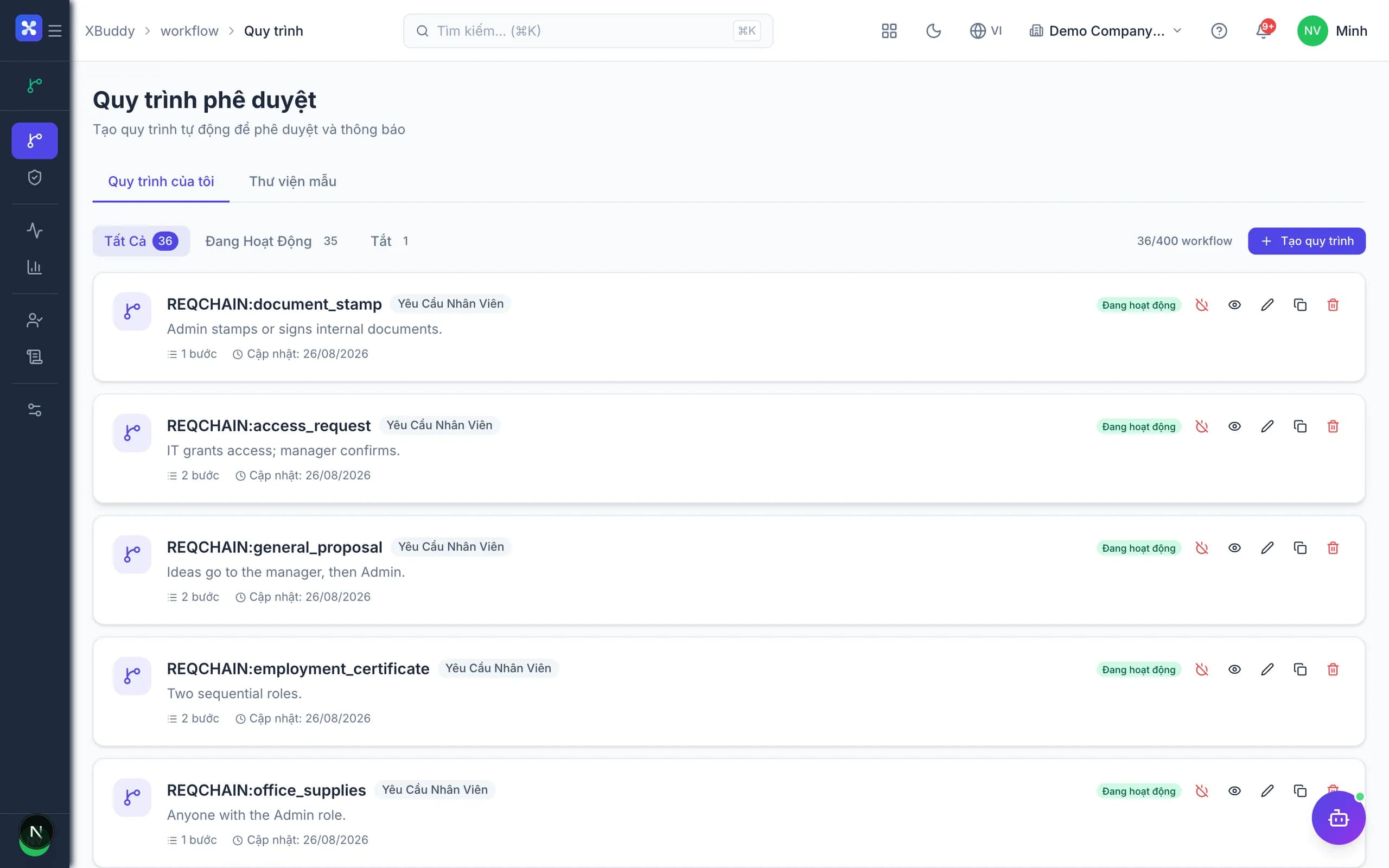
In XBuddy, the Workflow Management app lets you set threshold policies that decide when a document needs approval (with a dry run before applying them) and build multi-level approval chains, sequential or parallel. Amount thresholds compare against the amount converted to the company's base currency. The rule that preparers cannot approve their own items is a single shared check across every approval gate; the setting that allows self-approval is off by default. You can start from the workflow template library.

Delegation in XBuddy has a start date, an end date (or no end date if you choose), a scope by item type and a reason; it can be created from a leave request, and the system does not route an item to a delegate who is its own submitter. Every approval step has an audit trail, and there is a dedicated report on delegation activity. See the ready-made templates in the delegation template library. Approvers work in the inbox of the Approvals app; the Approvals Steward AI assistant sends reminders and prepares decision packs but never approves on anyone's behalf.
Frequently asked questions
Does a small business need an approval matrix?
Yes, though it can be very simple — for example two bands: below a threshold the department head approves, at or above it a director approves as well. The value of a matrix lies not in the number of levels but in everyone knowing who decides what, so nothing waits on one person.
Should thresholds use amounts before or after tax?
That is the business's choice, but pick one and apply it consistently across all document types in the same matrix. More important is that every threshold is in the company's base currency and compared with the converted amount, so foreign-currency documents do not slip to a lower level.
Can preparers approve their own items?
Under internal-control principles they should not. If a business is too small to separate the roles, allowing self-approval should be a deliberate decision applied uniformly wherever approvals happen and recorded, with compensating measures such as periodic review by the owner.
Does approval delegation need to be in writing?
That depends on internal policy and the type of transaction; for significant items many businesses require a written delegation decision. Either way, delegation in the system should have a time limit, scope, reason and an audit trail showing on whose behalf the delegate approved, so it can be verified in an audit.
How can we detect spend being split to avoid thresholds?
Periodically review documents from the same supplier and preparer within a short period whose total exceeds a threshold. Linking purchase orders to a requisition or budget line also surfaces the true total, and the policy should state clearly that splitting is a violation.