
Accounts receivable management for SMEs: ageing to reminders
Ageing reports, DSO, credit policy and staged payment reminders: how a small business gets paid on time without damaging customer relationships.
Small businesses rarely fail for lack of orders. They struggle because cash sits in customers' pockets for too long. Good accounts receivable management means knowing, every day, who owes you, for how long, and what the next step is for each balance. This article walks through four core tools — the ageing report, the DSO metric, a credit policy and a staged reminder playbook — then covers offsets, deposits and where AI belongs in the process.
Why accounts receivable management is a company-wide job
Receivables are revenue already recognised but not yet collected. Three teams act on them:
- Sales sets payment terms when closing the deal.
- Finance issues accurate invoices, sends them to the right person and applies receipts to the right balances.
- Management sets credit limits and decides when to stop shipping.
When each team keeps its own spreadsheet, "how much does this customer owe" has three answers. The first step in accounts receivable management is not chasing payment; it is having a single source of numbers read directly from invoices and receipts.
The ageing report: read it correctly before acting
An AR ageing report splits receivable balances by days past due. Common buckets:
| Bucket | Meaning | What to do |
|---|---|---|
| Not yet due | Normal | Nothing, or a pre-due reminder for habitual late payers |
| 1–30 days overdue | Usually forgotten or stuck in paperwork | Gentle reminder; check the customer received the invoice |
| 31–60 days overdue | Something is wrong | Call, ask why, agree a payment date |
| 61–90 days overdue | High risk | Escalate to the department head; consider pausing shipments |
| Over 90 days | Possibly doubtful | Formal reminder letter; consider a provision |
Three common reading mistakes:
- Looking at the total, not the customer. VND 500 million overdue could be 50 customers owing 10 million each, or one customer owing 450 million. They need different responses.
- Ageing from invoice date instead of due date. A customer on 60-day terms is not "overdue" on day 45.
- Ignoring unapplied payments. A customer who has paid, but whose receipt has not been matched to the invoice, shows as owing — and gets chased for nothing.
On provisions: under Circular 99/2025/TT-BTC (effective 1 January 2026), provisions for doubtful receivables are set as a percentage by ageing group, and companies may use another method where more appropriate. The ageing report therefore feeds the accounting numbers as well as collections. See also Circular 99/2025: how businesses should prepare.
DSO: one number that tells you how fast cash comes in
DSO (Days Sales Outstanding) shows the average number of days it takes for credit sales to turn into cash:
DSO = (Closing trade receivables ÷ Credit sales for the period) × Days in the period
Compare DSO with your average payment terms. If terms are 30 days and DSO is 50, customers are paying about 20 days late on average. The monthly trend matters more than the absolute number: DSO rising three months in a row is an earlier warning than any single overdue invoice.
Note that seasonality distorts DSO. A month with a revenue spike at period end makes DSO look better than it is. When revenue swings sharply, read DSO alongside the ageing report.
Illustrative example
Hypothetical figures. An equipment distributor has Q3 credit sales of VND 4.5 billion, closing receivables of VND 1.8 billion and typical terms of 30 days.
- DSO = 1.8 ÷ 4.5 × 92 ≈ 36.8 days, so customers pay about 7 days late relative to terms.
- The ageing report shows: 1.1 billion not yet due, 420 million 1–30 days overdue, 180 million 31–60 days overdue, 100 million over 90 days (from a single customer).
- Actions: gentle email reminders for the 1–30 bucket; phone calls to the three customers in the 31–60 bucket; for the customer over 90 days, stop taking new orders until a repayment schedule is agreed, and consider a provision.
If the 1–30 bucket is collected within the month, receivables fall by 420 million and next quarter's DSO, on the same revenue, drops to about 28 days.
Credit policy: decide before you ship
The hardest debt to collect is debt you should never have extended. A minimal credit policy covers:
- Per-customer credit limits: the maximum outstanding balance, reviewed periodically against payment history.
- Terms by customer group: new customers pay in advance or leave a deposit; long-standing customers get 30–45 days.
- Conditions for stopping shipments: for example, any balance more than 60 days overdue, or exceeding the limit.
- Who may grant exceptions: who can approve shipping to a customer over the limit, and where the exception is recorded.
A policy only works when it is checked at the moment the order is created, not when finance discovers the problem at month end.
A staged reminder playbook
Effective reminders are regular, early and escalating. A sample playbook:
| Milestone | Channel | Tone |
|---|---|---|
| 3 days before due | Invoice coming due, with bank transfer details | |
| 1 day after due | Gentle reminder; ask whether the invoice was received | |
| 7 days after due | Email + phone | Ask the customer to confirm a payment date |
| 30 days after due | Letter from the chief accountant | State the amount, previous reminders, and request a payment plan |
| 60 days after due | Management | Notify a shipment pause under the credit policy |
Three principles:
- Every reminder must carry exact figures: invoice number and remaining balance after partial payments. A reminder with the wrong amount damages credibility faster than no reminder at all.
- Distinguish late habits from genuine difficulty. A customer who usually pays on time and is 5 days late needs a gentle nudge; a customer 30 days late for the first time needs a call.
- Log every contact. Whoever picks up the file next must know how many reminders were sent and which date the customer promised.
Offsets and deposits: two common sources of error
Customer deposits are amounts received in advance, not revenue. If they are not tracked separately and offset against the invoice on delivery, the ageing report overstates receivables and the customer gets chased for money they already paid.
Offsetting happens when a partner is both a customer and a supplier. An offset needs a confirmation signed by both sides and must be posted to the books, not just "netted off" in a spreadsheet.
Returns and price reductions should go through a Credit Note linked to the original invoice, so that invoice's outstanding balance falls by the right amount.
Where software and AI help
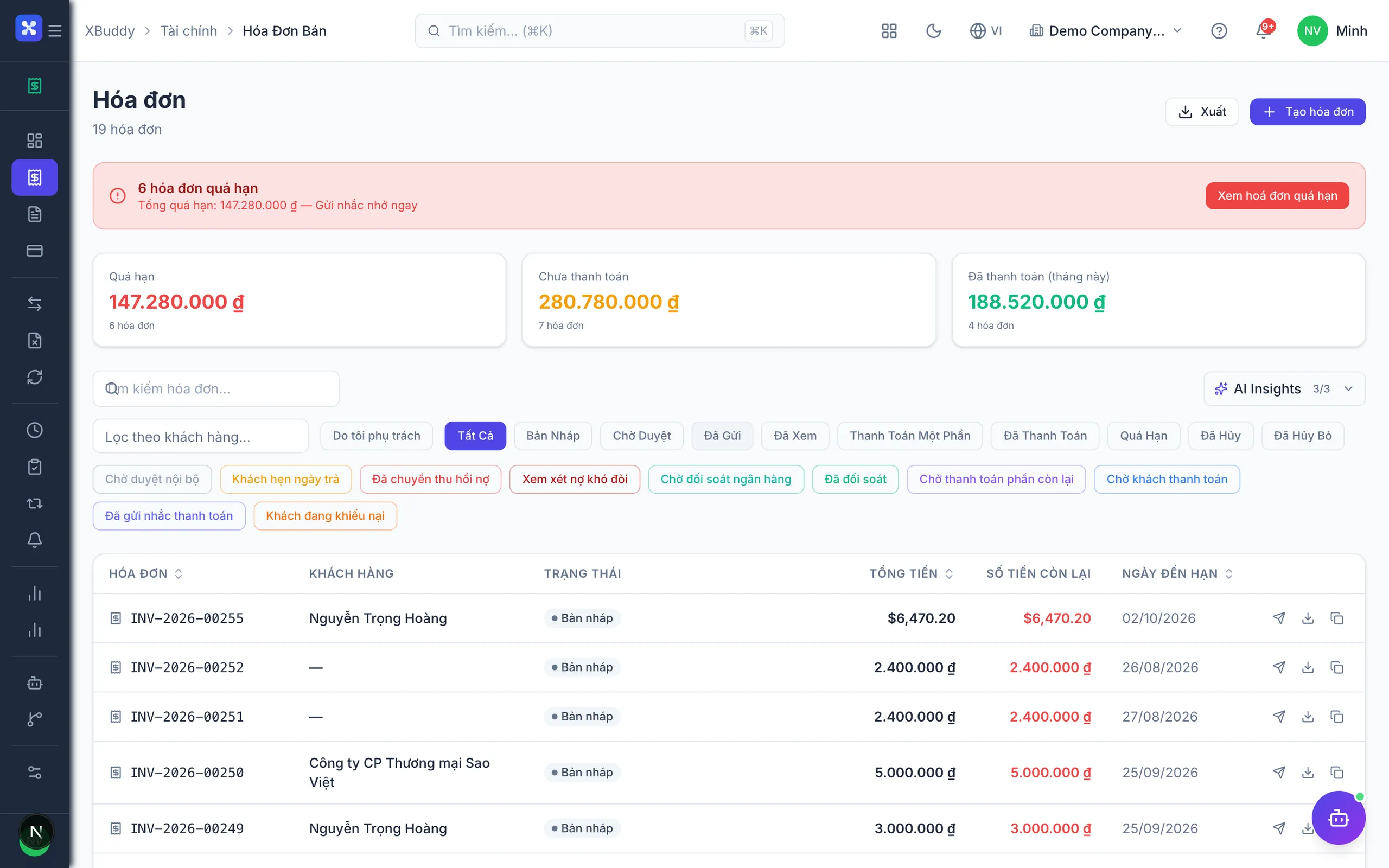
In the XBuddy Finance app, Invoices, Payments and Credit Notes live in one place, the AR ageing report reads directly from transaction data with per-customer detail, and dunning policies send reminders by overdue level with content and schedules you define. The full sales-to-cash process is described in the Order-to-Cash solution.
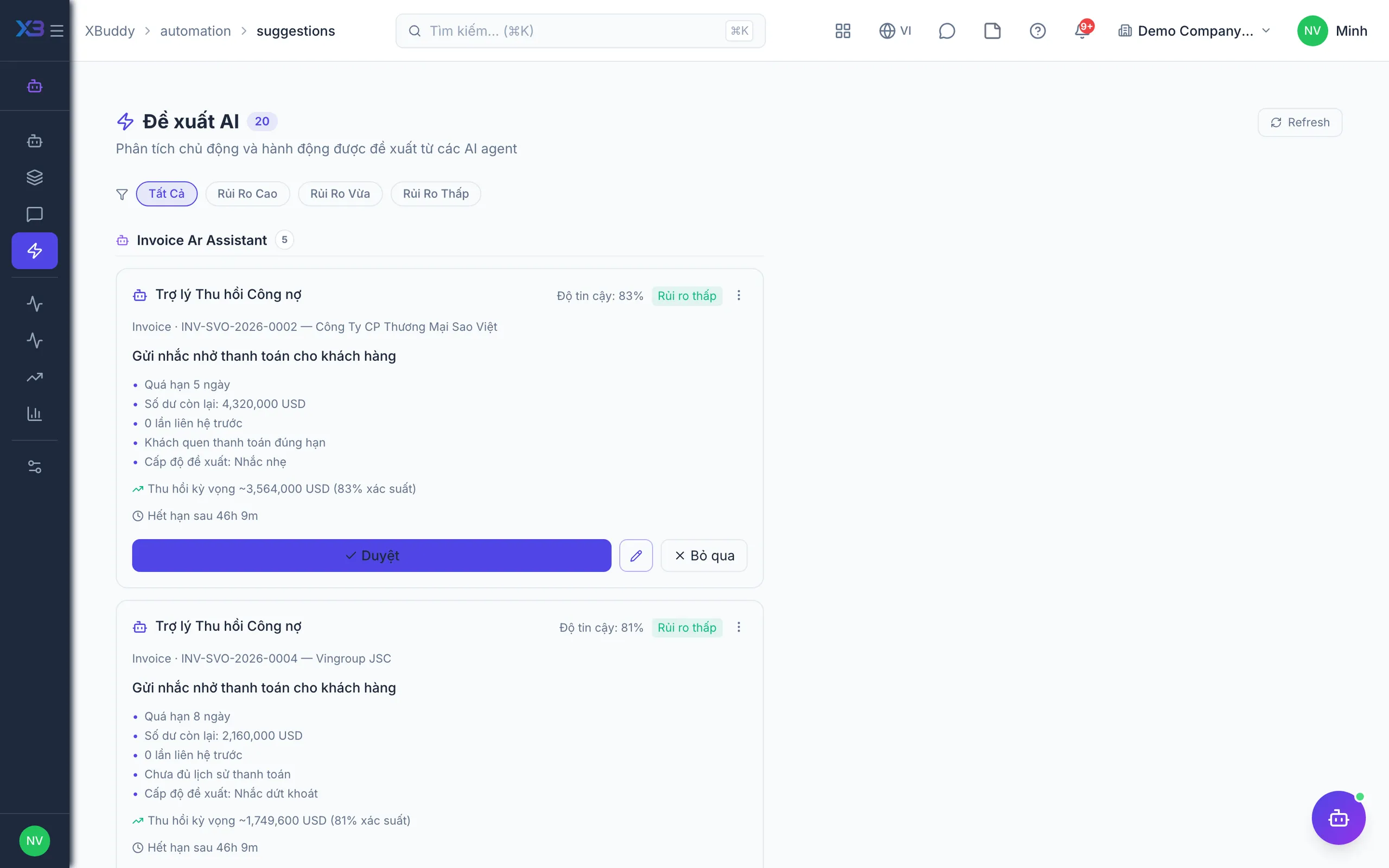
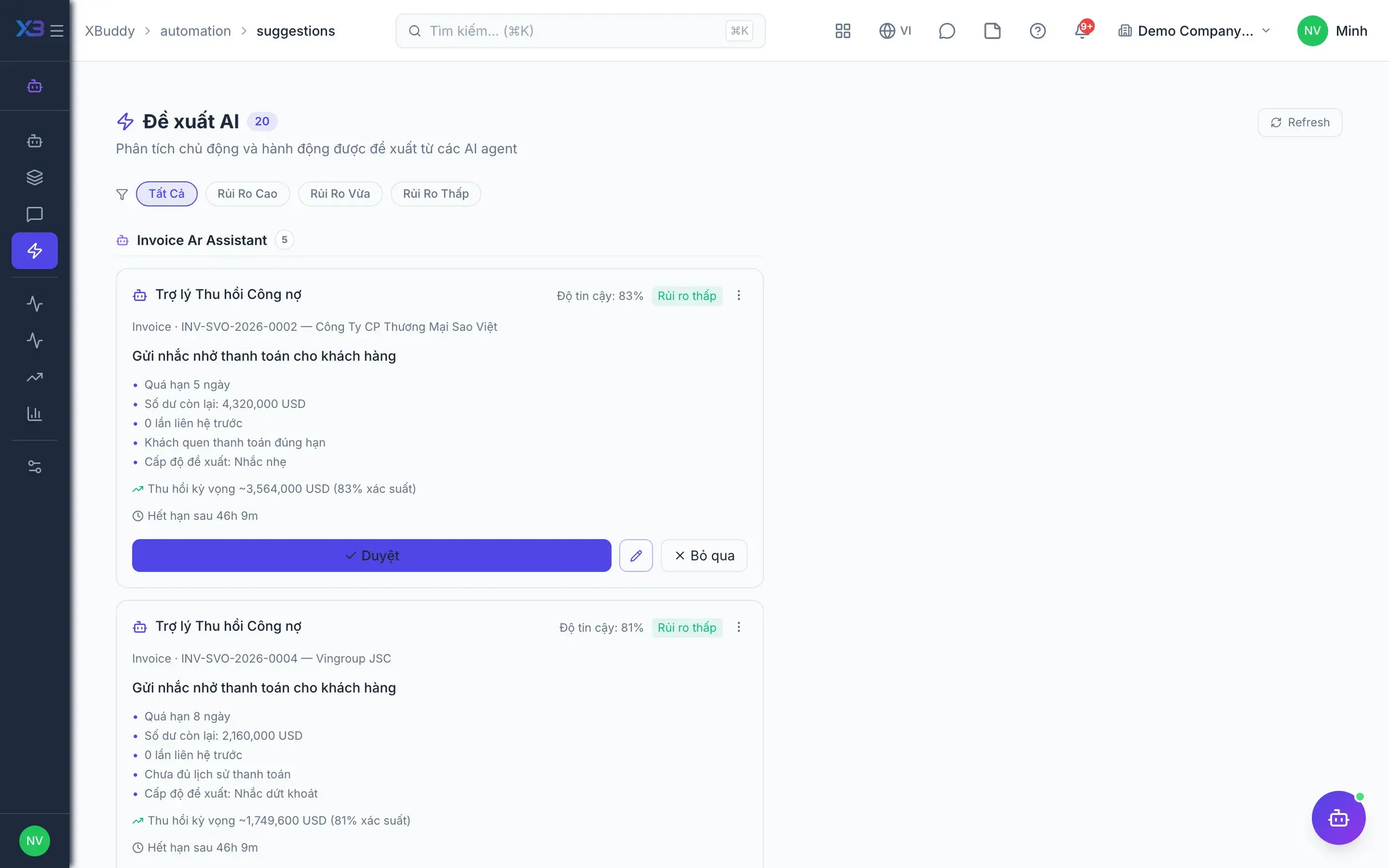
The AR Collector assistant analyses ageing, ranks the invoices that need chasing and drafts reminder messages; a message only goes out once someone approves it. That is the right division of labour: the system computes balances, AI proposes the order and the wording, and a person decides what reaches the customer. A reminder in the wrong tone sent to a key account can cost more than the debt itself.
Frequently asked questions
How many buckets should an ageing report have?
Common practice is not yet due, 1–30, 31–60, 61–90 and over 90 days overdue. More important than the number of buckets is ageing from the due date rather than the invoice date, and being able to drill down by customer.
What is a good DSO?
There is no universal figure across industries. Compare DSO with your own average payment terms: the closer DSO is to your terms, the better. The month-to-month trend tells you more than any single value.
When should I stop shipping to a customer who owes money?
When the customer breaches a condition written into your credit policy, such as a balance more than 60 days overdue or exceeding the credit limit. Check this when the order is created, and let only authorised people approve exceptions.
How do customer deposits affect receivables?
A deposit is an amount received in advance; track it separately and offset it against the invoice on delivery. Otherwise receivables are overstated and the customer may be chased for money already paid.
Should AI send reminder emails to customers on its own?
No. AI is well suited to analysing ageing, prioritising and drafting reminders, but sending should be a human decision. The balances in the message must come from the accounting system, not be calculated by the AI.