What usually goes wrong without it
Prepaid amortization, depreciation, accruals and FX revaluation are redone from spreadsheets every month. Missing one item distorts the whole period's P&L.
Close day arrives without a clear list of what is pending: subledgers not tied out, bank not reconciled, balances not confirmed.
Back-dated entries into a month already reported make the figures that were sent out stop matching the books.
Financial statements, notes and consolidated reports are rebuilt in Excel from exported balances, taking days and making it hard to trace back to documents.
7 steps, one chain of documents
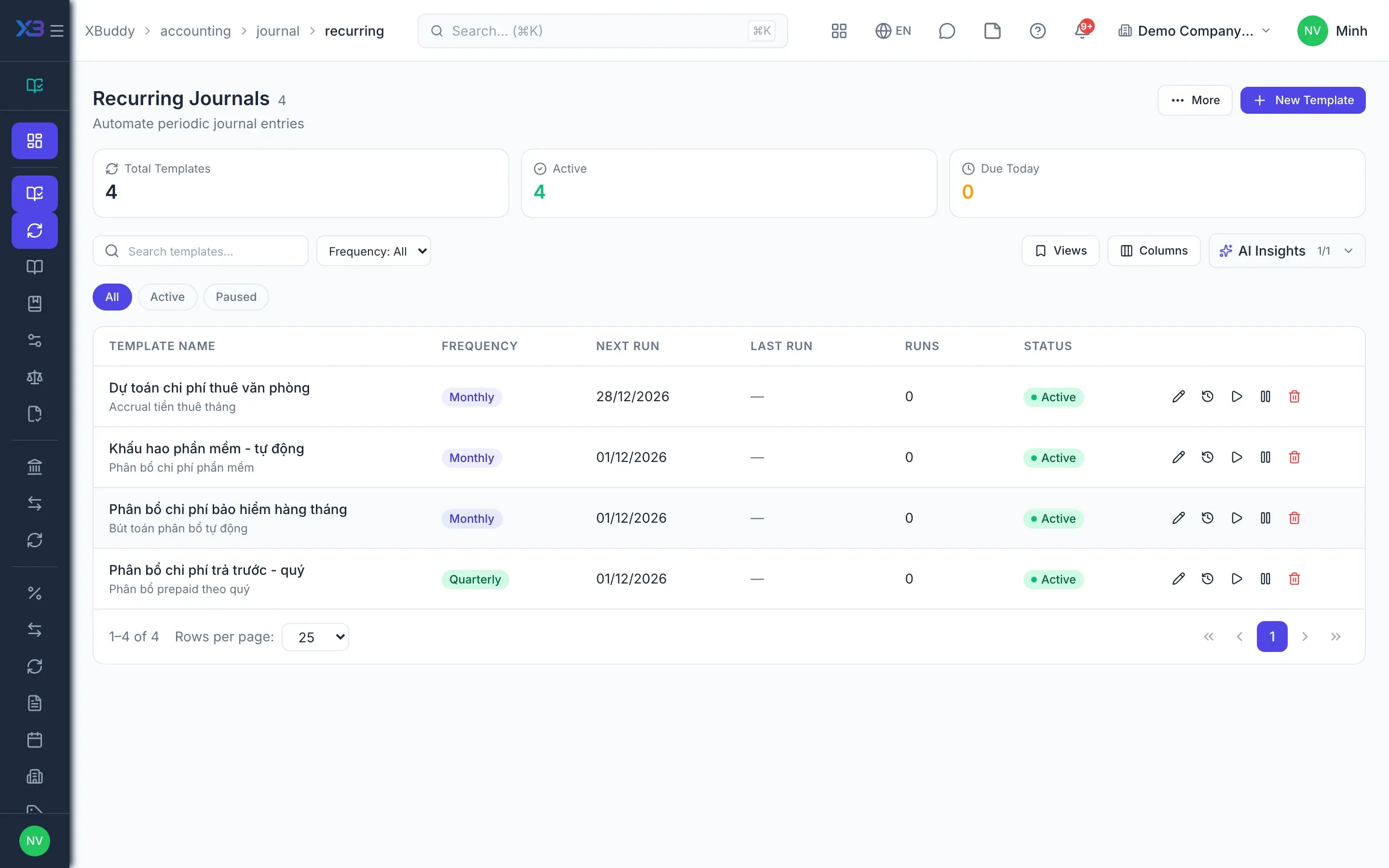
- 1Automatic and recurring entriesInvoices, payments, stock documents, payroll and expenses post journal entries as soon as the source document occurs. Monthly repeating entries such as rent or service fees are set up once as recurring entries that run on a schedule or on demand.
- Entries from sales, purchasing, inventory, payroll
- Scheduled recurring entries
- Posting rules and default accounts
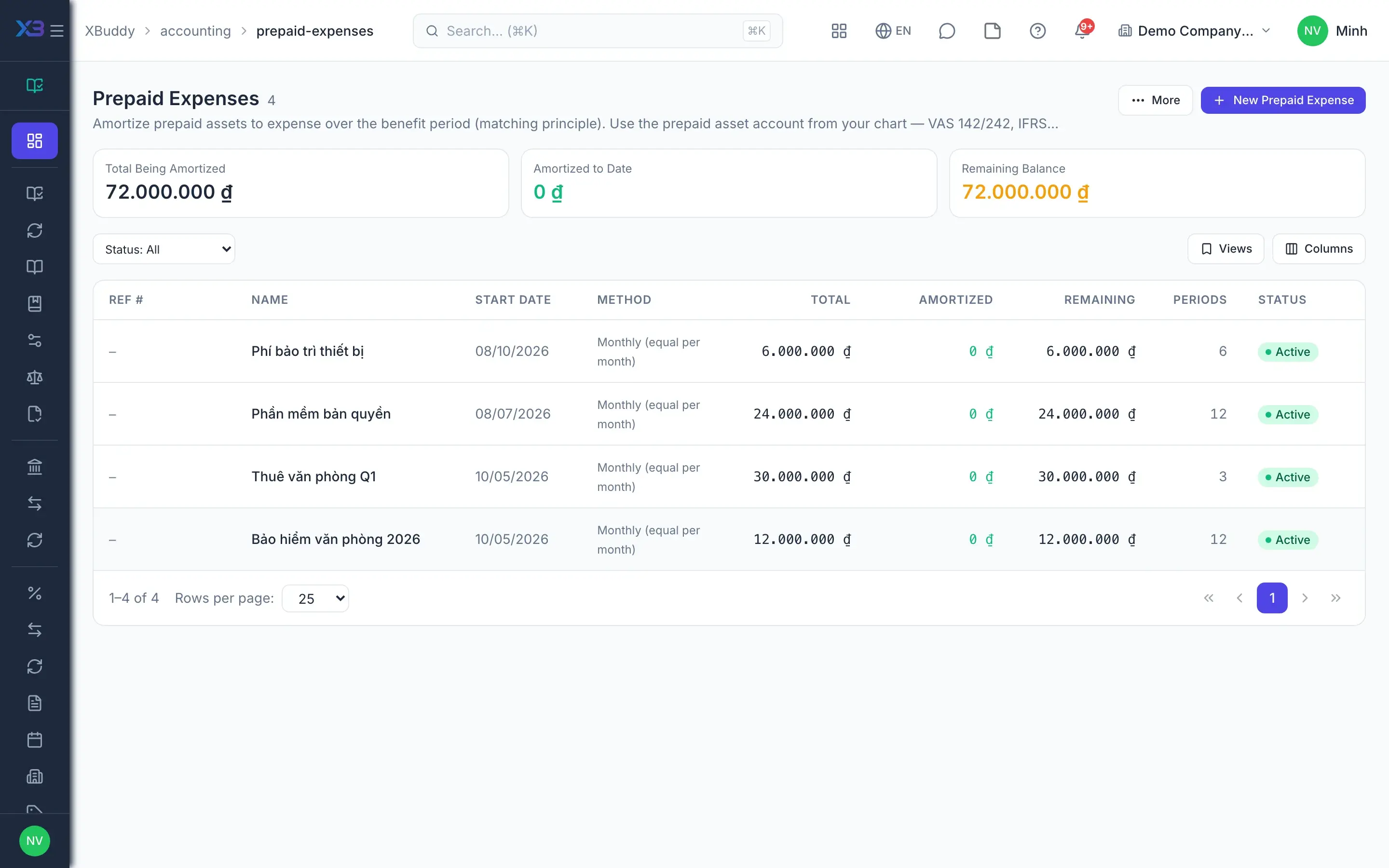
- 2Period-end adjustmentsPrepaid expenses are amortized by period, and fixed assets run depreciation into the open month while periods already run are skipped. Foreign-currency balances are revalued once a month after closing rates are entered; period-end inventory costing has its own run.
- Prepaid amortization and accruals
- Depreciation never runs twice for a period
- FX revaluation once per month
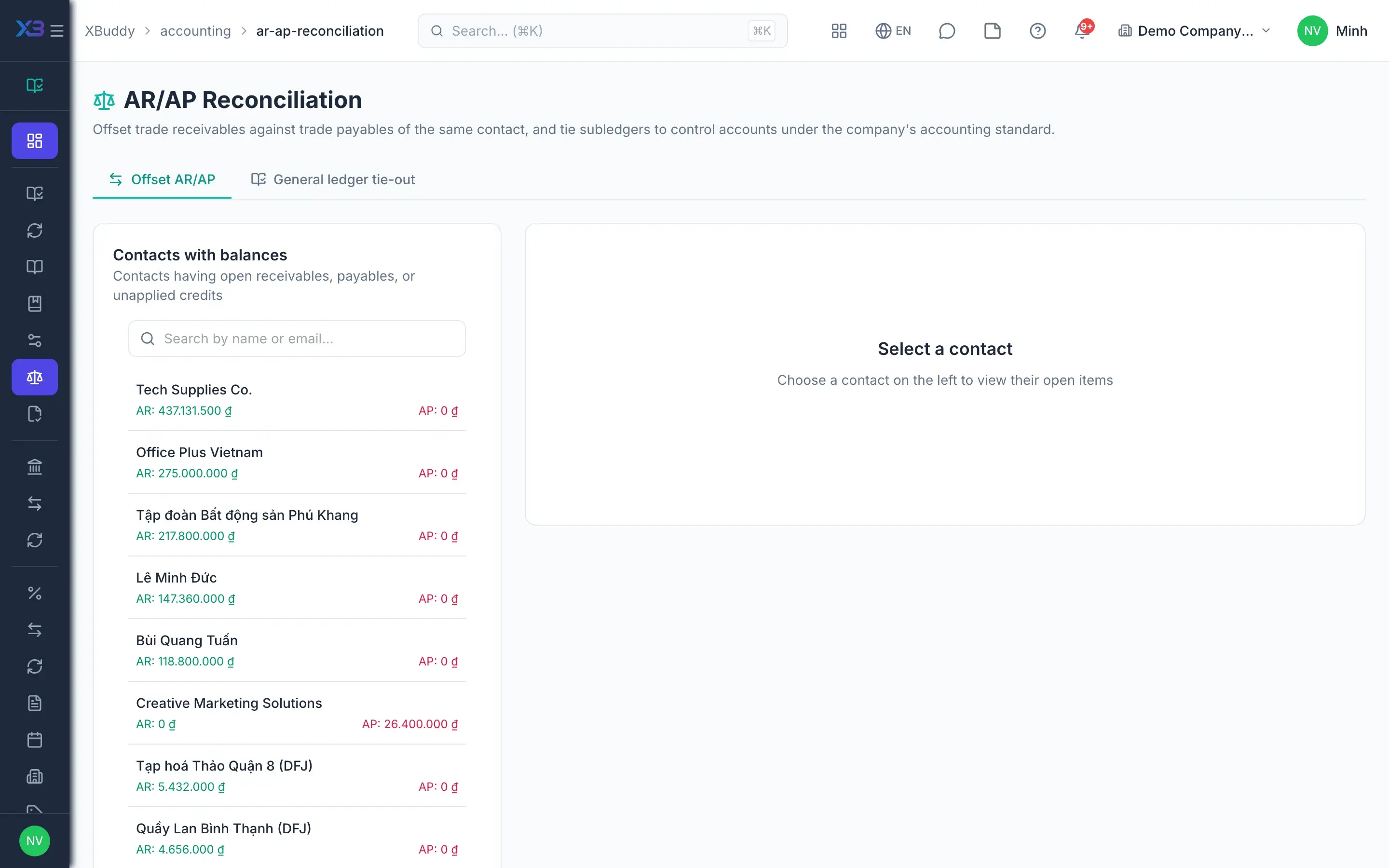
- 3Subledger and bank tie-outAccountants run the receivables and payables reconciliation to confirm subledger balances match the control accounts. Bank statements imported from file or through Casso and SePay connections are matched to ledger transactions before closing.
- Subledger tie-out against the GL
- Bank statement reconciliation
- Bank connections through Casso and SePay
- 4Debt confirmationsDebt confirmation letters are generated in batches for customers and vendors, freezing figures as of a date before sending. Partners reply through a link, paper replies are recorded, and disputed and no-response states are kept separate.
- Batch generation, attachments, PDF export
- Partners reply by link
- Disputed and no-response kept apart
- 5Close and lock the periodThe chief accountant starts a checklist-based close and the system lists the remaining blockers. Once the trial balance balances, the period is closed and then locked; with the flag on, postings into a locked period are blocked and adjustments go into the open period.
- Close checklist and blocker list
- Block postings into locked periods
- Year-end close and year rollover
- 6Statutory reports and returnsBalance sheet B01, income statement B02, cash flow B03 by the direct or indirect method, notes B09 and the trial balance are built from the ledger under the company's accounting standard. The 01/GTGT VAT return and its schedules come from the same ledger.
- TT200, TT133, TT99 per company
- B01, B02, B03, B09, trial balance
- 01/GTGT VAT return and amendments
- 7Management reports and consolidationLeadership sees financial health, P&L by cost center and dimension analysis. Companies with several legal entities in one account use a group chart, account mapping, elimination entries and worksheets to produce reviewed and approved consolidated reports.
- Financial health and ratios
- P&L by center, dimension analysis
- Consolidation with elimination entries
Every step is a familiar screen
6 real scenarios with how-tos
4 apps in this solution
Assistants that work the process with you
Journal Entry Assistant
Process-aware agent tracking journal entry lifecycle, flagging drafts left unposted
FP&A Analyst
Forecasts cash flow, analyzes revenue trends, and monitors budget variance and cross-domain anomalies.
Detailed paper: Record to report
End-to-end process, apps involved, AI assistant roles, KPIs and a 30/60/90-day rollout plan.
Can we keep books under TT133?
Yes. The standard is set per company, supporting TT200, TT133 and TT99, with a migration tool that previews and can be undone.
Can locked periods still receive postings?
With blocking of postings into locked periods on (the default), entries dated in a locked period are rejected; adjust in the open period or reopen the period under control.
Do financial statements need rebuilding in Excel?
No. B01, B02, B03, B09 and the trial balance are built directly from the ledger under the company's standard.
Can we consolidate companies outside the system?
Not yet. Consolidation works only between companies in the same XBuddy account; external trial balances cannot be imported.
We use MISA. Do we have to switch?
Not necessarily. The MISA AMIS Accounting integration pushes master data and documents.